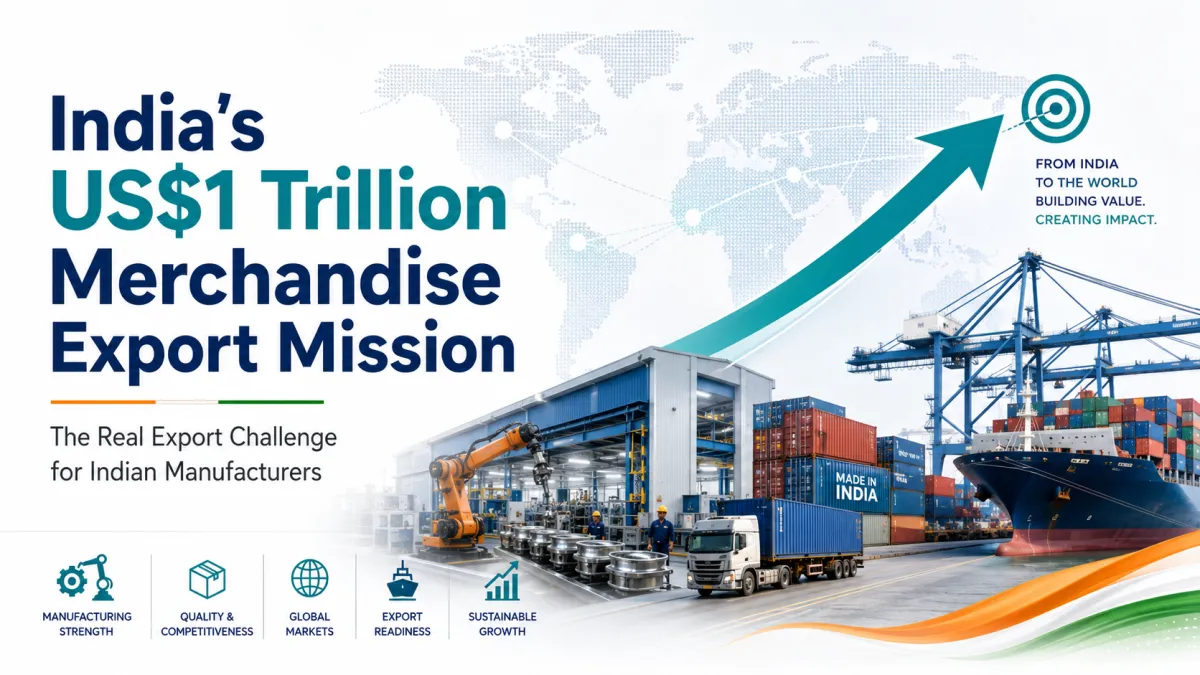
India’s US$1 Trillion Merchandise Export Mission: India’s Real Export Challenge
India wants to reach US$2 trillion in total exports by 2030–31.
The target is split into two large goals: US$1 trillion from merchandise exports and US$1 trillion from services exports.
This target will not be achieved only through more buyer outreach, more trade fairs, more government schemes or more export registrations.
It will be achieved on factory floors, inside testing laboratories, through costing sheets, compliance files, production planning meetings and buyer follow-ups.
The real question is simple:
Can Indian exporters build products and systems that overseas buyers trust enough to order again and again?
That is India’s real export challenge.

What India Is Trying To Achieve
The Government of India is targeting US$2 trillion in total exports by 2030–31.
Out of this, US$1 trillion is expected from merchandise exports and US$1 trillion from services exports.
In FY 2025–26, India recorded estimated total exports of US$860.09 billion. This included US$441.78 billion in merchandise exports and US$418.31 billion in services exports.
Total exports grew by 4.22%, but merchandise exports grew by only 0.93%.
This difference is important.
Services exports are already close to merchandise exports. But manufacturing, agriculture and product exports must more than double in around five years.
That is not a small jump.
To move from US$441.78 billion to US$1 trillion in merchandise exports by FY 2030–31, India needs around 17.8% compounded annual growth.
The rough path looks like this:
FY 2025–26: US$441.78 billion
FY 2026–27: around US$520 billion
FY 2027–28: around US$613 billion
FY 2028–29: around US$722 billion
FY 2029–30: around US$850 billion
FY 2030–31: around US$1 trillion
This means India must add nearly US$78 billion in merchandise exports in the first year itself.
Every year after that, the additional value required becomes even bigger.
The target is not impossible. But it is demanding.
India cannot reach this target only because the world market grows. The WTO expects world merchandise trade volume to grow by about 1.9% in 2026.
India needs much faster growth.
So India must do three things at the same time:
Take market share from competing supplier countries.
Enter product categories where global demand is rising.
Earn more value from every shipment.
This requires stronger export capability, not just more exporters.

India has a great vision: USD 2 Trillion by 2030.
Consult Kriba has created a free WhatsApp community to support this mission: India 2030: USD 2 Trillion.
It includes dedicated sector-wise groups for:
Market intelligence
Policy updates
Exporter networking
To join the community, fill out this form:
https://www.consultkriba.com/india2030
India Does Not Need Only More Registered Exporters
Getting an IEC is important.
But an IEC only allows a business to participate in international trade. It does not prove that the business is ready to serve an overseas buyer.
Export capability means the business can:
Manufacture a clearly defined product.
Maintain the same specification across batches.
Understand destination country rules.
Prepare correct export documents.
Calculate a safe export price.
Deliver within the committed timeline.
Respond properly when quality or shipment issues arise.
Finance the production and payment cycle.
Support the buyer after delivery.
Many Indian businesses are good domestic manufacturers. But export business is different.
A domestic buyer may accept small specification changes, flexible delivery or informal communication.
An overseas buyer may face customs delays, retail penalties, factory stoppage, product liability or damage to their own brand if the supplier fails.
So overseas buyers do not want only a catalogue.
They want proof that the exporter can control risk.
Shift 1: From Registration To Capability
India’s first big shift must be from exporter registration to export capability.
A registered exporter may be legally allowed to export.
A capable exporter is commercially ready to serve international buyers.
This difference matters.
A buyer may ask:
Can you repeat the same quality after sample approval?
Can you deliver on time?
Can you support documents correctly?
Can you manage payment terms?
Can you handle complaints professionally?
Can you continue supply for the full season or annual programme?
If the answer is weak, buyer outreach will not solve the problem.
The exporter may get enquiries. But enquiries will not turn into strong orders.
Shift 2: From Catalogue To Product-Market Fit
Many Indian manufacturers start exports by sending their full catalogue to hundreds of buyers.
This is usually a weak approach.
A catalogue may contain 50, 100 or 500 products. But the overseas buyer is not asking, “What all can you sell?”
The buyer is asking:
Can you supply the exact product we need, with the correct specification, compliance, price, packaging and delivery schedule?
For example, a pump manufacturer should not only say:
“We manufacture all types of pumps.”
A stronger position is:
“We manufacture stainless-steel chemical-process pumps for mid-sized process plants, with defined material grades, duty points, test records, spare-part support and documented lead times.”
A garment manufacturer should not only say:
“We export all types of garments.”
A stronger position is:
“We manufacture private-label organic cotton sleepwear for small and mid-sized UK retailers, with size-set control, shrinkage testing, low-MOQ production and buyer-specific packaging.”
This focus changes everything.
Market research becomes clearer.
Competitor comparison becomes easier.
Compliance requirements become visible.
Buyer lists become more accurate.
Product communication becomes more credible.
Costing becomes more precise.
Sample planning becomes easier.
Follow-up conversations become more useful.
India will not reach US$1 trillion by exporting every possible product to every possible country.
It will reach there through thousands of strong product-country-buyer combinations.
Shift 3: From First Order To Repeat Business
A first export order is only a trial.
It proves that a buyer was willing to test the supplier.
It does not yet prove that the exporter is internationally competitive.
A first order may come because of a low price, urgent buyer shortage, personal reference, trade fair meeting, small trial quantity or competitor failure.
The second and third orders are more important.
They show whether the exporter maintained quality, met delivery timelines, handled documents correctly, communicated properly and helped the buyer make money.
India’s US$1 trillion merchandise export target cannot be built on one-time trial shipments.
It needs exporters who can convert:
Trial order into repeat order.
Repeat order into annual programme.
One product into a related product range.
One customer into a country reference.
One market into a regional position.
Repeat business reduces the cost of finding customers.
It also improves production planning, cash flow and revenue visibility.
That is why India’s export target is not only an export promotion challenge.
It is a supplier performance challenge.

Where Can India’s Export Growth Come From?
India’s export growth must come from many sectors. But each sector needs deeper capability, not only more promotion.
Engineering Goods
Engineering goods were India’s largest merchandise export category in FY 2025–26, at around US$122.43 billion.
This sector includes industrial machinery, pumps, valves, castings, forgings, auto components, electrical equipment, steel products, process equipment, precision-machined parts and agricultural machinery.
India has strong manufacturing clusters and engineering talent.
But overseas buyers do not buy “engineering goods.”
They buy a part, machine or component that must perform a specific function.
A Coimbatore pump manufacturer targeting the UAE or Europe should not start with a general brochure.
It should answer:
Which pump type are we selling?
What material grade is required?
Which industry application are we targeting?
Are we selling to distributors, EPC contractors, OEMs or plant operators?
Are we competing with China on price, Turkey on flexibility, Italy on design or Germany on technical reputation?
What test records, certificates and technical documents are needed?
Will revenue come only from pump sales, or also from spares and service support?
The exporter who answers these questions can build a market position.
The manufacturer who sends a generic brochure remains one supplier among many.
Electronics
Electronic goods exports increased strongly in FY 2025–26 and reached around US$47.96 billion.
India has made major progress in mobile phones and electronics production.
But the next stage cannot depend only on final assembly.
India needs deeper value addition in components, printed circuit assemblies, battery systems, sensors, power electronics, industrial controls, telecom equipment, medical electronics and semiconductor-related inputs.
China, Vietnam, Malaysia, Thailand and Mexico are already strong in electronics supply chains.
So India must compete on more than labour cost.
Buyers will check traceability, failure rates, testing capacity, design security, intellectual-property protection, engineering change control and speed of corrective action.
A Pune electronics manufacturer seeking OEM orders should not show only factory size and machinery.
It should show how it manages component approval, revision control, testing, non-conformance and continuity of supply.
That is the difference between production capacity and buyer-ready capacity.
Pharmaceuticals And Chemicals
India exported around US$31.12 billion in drugs and pharmaceuticals and around US$28.67 billion in organic and inorganic chemicals during FY 2025–26.
India is strong in generics, APIs, formulations, specialty chemicals and contract manufacturing.
But in these sectors, compliance is part of the product.
A pharmaceutical buyer may check regulatory approvals, inspection history, data integrity, stability records, contamination controls, change-control systems, API source continuity and recall procedures.
A chemical buyer may check composition, safety data, restricted substances, batch consistency, storage requirements, packaging, transport classification and environmental information.
Low price may bring an enquiry.
Technical confidence is more likely to bring repeat business.
Textiles, Apparel, Leather And Processed Food
Labour-intensive sectors are important for India because they create employment and support MSMEs.
India has strong capabilities in cotton, textiles, garments, leather, footwear, spices, marine products and processed food.
But competition is strong.
Bangladesh and Vietnam compete in apparel scale. Turkey offers speed to Europe. China competes across production breadth. Southeast Asian countries are strong in processed food and private-label manufacturing.
Indian exporters must become more precise.
A Tiruppur apparel manufacturer targeting UK private-label buyers may need to prove fabric composition, shrinkage control, size consistency, chemical compliance, ethical sourcing, production lead time, packaging and repeat-season capacity.
A Maharashtra food processor targeting the UAE may need correct ingredient classification, shelf-life proof, Arabic-compliant labelling, allergen information, halal documentation where required, heat-resistant packaging, importer support and distributor margin clarity.
The product may already sell well in India.
But export opportunity begins only when the product is adapted to the buyer’s market.
How Government Support Helps
Government policy cannot manufacture the product.
It cannot manage buyer communication.
It cannot replace quality control.
But it can reduce the cost and difficulty of becoming export-ready.
The Export Promotion Mission has a total outlay of ₹25,060 crore for FY 2025–26 to FY 2030–31.
It has two major parts.
Niryat Protsahan focuses on affordable trade finance, interest support, export factoring, collateral guarantees and new-market expansion.
Niryat Disha focuses on quality, compliance, branding, packaging, trade fairs, export warehousing, logistics, trade intelligence and exporter training.
This support is useful only when connected to a real export capability gap.
An exporter should not ask only:
“Which subsidy can I get?”
A better question is:
“Which missing capability is stopping us from serving the selected buyer?”
For example:
Finance support can help fund production.
Better production can improve delivery reliability.
Reliable delivery can build buyer confidence.
Buyer confidence can improve repeat-order chances.
Similarly, certification support can help market access.
Market access can reduce buyer risk.
Lower buyer risk can improve the quality of enquiries.
Government support matters most when the exporter has a clear product, market and buyer plan.
Logistics And Infrastructure Matter
Logistics is also part of export competitiveness.
India has improved its logistics performance over the years. Government infrastructure efforts like PM GatiShakti, National Logistics Policy, port modernisation, ULIP and Logistics Data Bank are intended to improve freight planning and cargo visibility.
For exporters, this should lead to better route planning, more predictable transit time, better shipment visibility, fewer avoidable delays and stronger buyer communication.
But exporters must not depend only on national infrastructure improvement.
Every exporter must measure their own full delivery cycle.
That means tracking the time from raw-material purchase to production, packing, documentation, customs clearance, shipment, destination arrival and buyer receipt.
A buyer does not judge only the port.
The buyer judges the complete supply experience.
Trade Agreements Create Access, Not Automatic Sales
Trade agreements can reduce duty and improve market access.
But they do not create automatic orders.
India has expanded trade relationships with markets such as the UAE, Australia, EFTA and the UK, while working on more agreements.
Different agreements serve different commercial purposes.
The UAE CEPA supports Gulf access, logistics, re-export and links to the Middle East and Africa.
Australia ECTA supports staged market access and a wider Indo-Pacific relationship.
UK CETA covers goods, services, mobility, customs, standards and broader economic cooperation.
But exporters must not stop at the announcement.
They must check:
Entry-into-force date.
HS-code concession.
Tariff reduction schedule.
Product-specific rules of origin.
Certificate of origin procedure.
Technical requirements.
Buyer’s ability to claim the concession.
Competing countries that already have similar access.
A 10% duty advantage can help.
But it can disappear if the exporter has higher freight, longer lead time, weak packaging, low productivity or costly rejections.
Trade agreements open doors.
Export capability helps the exporter enter and stay.
Country Roles In India’s Export Vision
United States
The United States offers large opportunities in engineering, electronics, pharmaceuticals, food, home products and consumer goods.
But the market also has high expectations around product liability, documentation, customs and after-sales support.
The right buyer may be an importer, distributor, OEM, retailer, private label or institutional buyer.
Each buyer type needs a different offer.
European Union And United Kingdom
Europe and the UK can offer strong opportunities for engineering, textiles, chemicals, food, furniture, pharmaceuticals and sustainable products.
But these markets demand deeper proof.
Buyers may look at product safety, standards, traceability, responsible sourcing, environmental information, packaging and brand reputation.
The EU Carbon Border Adjustment Mechanism entered its definitive phase in 2026 for covered carbon-intensive goods.
This means environmental compliance should not be treated only as a CSR topic.
For some products, it can directly affect cost, buyer approval and market access.
UAE And Middle East
The UAE is both a market and a regional distribution route.
Useful areas include food, jewellery, engineering products, building materials, healthcare products, consumer goods and hospitality supplies.
Exporters may need Arabic labelling, distributor support, product registration, halal proof where relevant and fast replenishment.
East And Southeast Asia
Japan, South Korea, Singapore and Southeast Asian markets can offer opportunities in components, machinery, materials, chemicals and specialised food products.
These buyers may expect technical accuracy, stable quality and a long-term supplier improvement mindset.
Africa And Emerging Markets
Africa and other emerging markets can offer demand for pharmaceuticals, electrical products, machinery, vehicles, food and construction materials.
But exporters must carefully study distributor capability, payment security, foreign exchange availability, local registration, spare-parts support, port and inland logistics, political risk and regulatory risk.
High demand does not always mean safe revenue.
What Overseas Buyers Fear
Overseas buyers are not rejecting Indian suppliers because they dislike India.
They are trying to avoid commercial loss.
Their fears are practical.
Specification Risk
The sample may be correct, but production batches may vary.
Exporter proof needed:
Approved specification, tolerance sheet, QC plan, inspection report and batch records.
Compliance Risk
The product may fail safety, technical, environmental or labelling rules.
Exporter proof needed:
Certificates, test reports, technical file, declarations and label approval.
Delivery Risk
A late shipment may stop production or miss a retail season.
Exporter proof needed:
Capacity plan, material plan, production schedule, freight route and early-warning process.
Cost Risk
The quote may exclude tooling, testing, packing, freight, bank charges or after-sales cost.
Exporter proof needed:
Clear EXW, FOB, CIF and landed-cost logic with quote validity and payment terms.
Communication Risk
The supplier may promise quickly but explain problems late.
Exporter proof needed:
Written commitments, named responsibility, response timeline and escalation process.
Reputation Risk
The buyer may face ethical sourcing, labour, environmental or traceability questions.
Exporter proof needed:
Factory profile, supplier code, sourcing records, audit evidence and corrective-action process.
Continuity Risk
The supplier may depend on one imported material, one machine or one technical person.
Exporter proof needed:
Critical input map, alternate-source plan, maintenance plan and business-continuity process.
The exporter does not need to claim that no problem will ever happen.
The exporter must prove that problems can be detected, communicated and controlled.
The Reverse Sourcing Method View
The Reverse Sourcing Method connects the national export opportunity to a practical business decision.
The chain is:
National opportunity → Sector → Country → Buyer → Product → Competition → Compliance → Channel → Revenue
Take the example of an Indian industrial pump manufacturer.
The national opportunity is clear: engineering is already India’s largest merchandise export category and is central to the 2030 target.
The sector is industrial fluid-handling equipment.
The country decision may compare the UAE, Saudi Arabia, Germany and the UK based on project demand, import structure, freight, standards and competition.
The buyer decision separates EPC contractors, industrial distributors, plant operators and OEMs.
The product decision selects a limited range of stainless-steel process pumps for specific applications.
The competition study compares Chinese pricing, Turkish flexibility, Italian product presentation and German technical reputation.
The compliance work prepares material certificates, performance-test records, drawings, quality controls and destination documentation.
The channel decision may show that a trained technical distributor is better than direct quotations to every plant.
The revenue model includes the pump, spare kits, replacement parts and repeat maintenance demand.
Now the exporter has a market-entry model.
Without this chain, the business has only a product and hope.

The 12-Point India Vision 2030 Exporter Scorecard
Before increasing buyer outreach, exporters should score their readiness.
Give each area a score from 0 to 2.
0 means not known.
1 means partly understood.
2 means documented and usable.
1. Product Focus
Can you define one product family, specification range and application?
2. Market Evidence
Do you know which countries import the product and why demand exists?
3. Buyer Definition
Can you name the exact buyer type and its commercial role?
4. Competition
Do you know the leading supplier countries and their price, quality, delivery or design advantage?
5. Compliance
Have you identified and prepared the required standards, tests, labels and technical documents?
6. Commercial Readiness
Can you calculate EXW, FOB, CIF, buyer landed cost, safe margin and quote validity?
Score Meaning
10–12: Ready for controlled buyer outreach.
7–9: Good opportunity, but proof gaps remain.
4–6: Product or market decision needs more work.
0–3: Do not scale outreach. Build export capability first.
What Indian Manufacturers Should Do In The Next 90 Days
The next 90 days should not be spent sending random messages to buyers.
They should be used to build a controlled export plan.
Days 1–15: Select
Choose one product family.
Confirm the HS code.
Select two or three possible countries.
Identify the correct buyer types.
Remove unsuitable markets.
Days 16–35: Investigate
Study import demand.
Compare supplier countries.
Check tariffs and trade agreement benefits.
Identify compliance requirements.
Estimate freight and landed cost.
Days 36–55: Prepare Proof
Build a product specification sheet.
Organise test reports and certificates.
Document capacity, MOQ and lead time.
Prepare sample and QC procedures.
Complete export costing.
Days 56–70: Build The Market List
Find relevant importers, distributors, manufacturers or retailers.
Separate them by buyer type.
Record their current product range.
Identify why your product may fit each company.
Days 71–90: Test Outreach
Contact a small group of high-fit buyers.
Use a product-specific message.
Record objections and unanswered questions.
Improve the offer before contacting a larger buyer group.
This method may produce fewer messages at the beginning.
But it gives better commercial learning and stronger buyer conversations.
Final Takeaway
India’s Export Vision 2030–31 will not be achieved by one policy, one trade agreement or one large company.
It will be built by thousands of Indian manufacturers making better product, market, compliance and buyer decisions.
The real challenge is not only to find buyers.
The real challenge is to become the kind of exporter that buyers can trust for repeat business.
Take one product from your business.
Score it against product focus, market evidence, buyer definition, competition, compliance and commercial readiness.
If the proof is weak, do not rush to send more buyer messages.
Build the capability that makes the right buyer willing to place the second order.

Build Your AI Team For Exports
India’s export growth will need faster research, sharper buyer targeting, better follow-up and stronger decision-making.
That is why Consult Kriba has created AI Team for Exporters — a practical setup to help exporters use AI for market research, buyer discovery, communication, content, follow-up and export sales support.
This is not about replacing exporters.
It is about helping Indian exporters work with better speed, clarity and consistency.
Join AI Team for Exporters:
https://www.consultkriba.com/ait
Source List
Government of India: FY 2025–26 trade performance
Government of India: US$2 trillion export target and sector monitoring
CII: Achieving US$1 Trillion Merchandise Exports by 2030
Department of Commerce: Merchandise export sector performance
WTO: Global Trade Outlook, March 2026
Government of India: Export Promotion Mission and MSME support
Department of Commerce: Recent Indian trade agreement highlights
Government of India: Infrastructure and logistics progress
European Commission: Carbon Border Adjustment Mechanism
European Commission: Deforestation Regulation
