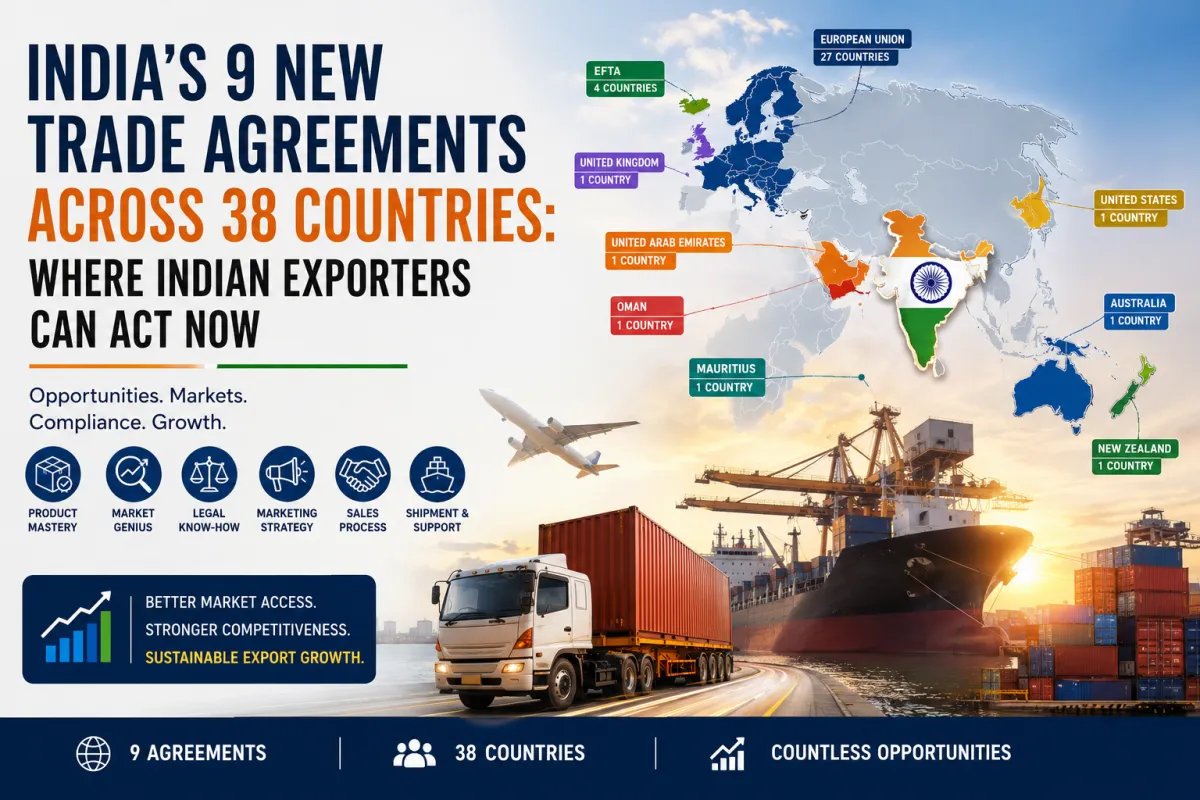
India’s 9 New Trade Agreements Across 38 Countries: Where Indian Exporters Can Act Now
India has created one of the most important trade-policy openings in its recent history.
The Government’s recent trade-agreement programme covers nine arrangements spanning 38 countries. These include the UAE, Australia, the United Kingdom, Oman, New Zealand, the four EFTA countries, the 27 European Union members, Mauritius and the United States.
Together, these markets connect Indian businesses with high-income consumers, Gulf distribution centres, European industrial buyers and some of the world’s largest import markets.
But an agreement does not create an export order.
It only changes the conditions under which an Indian company competes.
The exporter must still identify an eligible product, satisfy the rule of origin, meet the destination’s regulations, calculate the landed cost, select the right buyer and prove that the business can supply consistently.
That is where the commercial value of an FTA is either captured or lost.
India has a great vision: USD 2 Trillion by 2030.
Consult Kriba has our free WhatsApp community to support this mission: India 2030: USD 2 Trillion
It has dedicated sector-wise groups for:
Market intelligence
Policy updates
Exporter networking
To join the community, fill out this form:
https://www.consultkriba.com/india2030

How the Government Arrives at 38 Countries
The Government’s 38-country calculation combines the following arrangements:
Mauritius CECPA — 1 country
UAE CEPA — 1 country
Australia ECTA — 1 country
EFTA TEPA — 4 countries
United Kingdom CETA — 1 country
Oman CEPA — 1 country
New Zealand FTA — 1 country
European Union FTA — 27 countries
United States interim framework — 1 country
Total — 38 countries
The number is important, but the legal status is more important.
Not every arrangement is currently available for exporters to claim preferential duty.

Which Agreements Can Exporters Use Now?
Operational agreements
As of 13 July 2026, the following agreements are operational:
India–Mauritius CECPA, effective from 1 April 2021
India–UAE CEPA, effective from 1 May 2022
India–Australia ECTA, effective from 29 December 2022
India–EFTA TEPA, effective from 1 October 2025
India–Oman CEPA, effective from 1 June 2026
Entering into force shortly
The India–UK CETA will enter into force on 15 July 2026.
Exporters can prepare their product, origin proof and buyer communication now. However, the new CETA preference cannot legally be claimed for a shipment before the agreement becomes operational.
Signed but not yet operational
India and New Zealand signed their FTA on 27 April 2026.
The agreement promises zero-duty access for eligible Indian exports from its entry into force. However, the tariff benefit was not yet operational on 13 July 2026.
The India–New Zealand joint statement issued after the leaders’ meetings on 10 and 11 July 2026 confirmed that both sides were still working towards the agreement’s early entry into force.
Negotiations concluded, but implementation pending
India and the European Union announced the conclusion of FTA negotiations on 27 January 2026.
Legal review, signing, ratification and implementation are still required before exporters can claim the new tariff preference.
Framework under negotiation
India and the United States announced a framework for an interim trade agreement in February 2026.
It is an important commercial development, but it is not the same as a fully implemented FTA. Negotiations towards finalising the interim agreement and a wider bilateral trade agreement continue.
This legal distinction protects exporters from promising buyers a duty saving that customs may not allow.
What CECPA, CEPA, ECTA, TEPA and CETA Mean
The names are different because the agreements differ in scope.
An FTA, or Free Trade Agreement, mainly reduces tariffs and other trade barriers. Modern FTAs may also cover services, customs procedures, digital trade, investment and technical standards.
A CEPA, or Comprehensive Economic Partnership Agreement, is usually broader. It may cover goods, services, investment, professional movement, customs cooperation and regulatory matters.
An ECTA, or Economic Cooperation and Trade Agreement, can provide early or interim market access while the countries continue negotiating a wider agreement.
A CECPA, or Comprehensive Economic Cooperation and Partnership Agreement, combines product-level preferences with wider economic cooperation.
A TEPA, or Trade and Economic Partnership Agreement, combines trade access with investment, services and economic partnership commitments.
A CETA, or Comprehensive Economic and Trade Agreement, normally covers goods, services and wider areas such as professional mobility, customs, investment and digital trade.
The title does not tell an exporter whether a product receives zero duty.
That answer comes from five checks:
The product’s correct HS code
The destination’s tariff schedule
The tariff-reduction period
Any quota or exclusion
The product-specific rule of origin

What the Operational Agreements Have Achieved
Trade growth after an FTA should be interpreted carefully.
Exports can rise because of economic recovery, exchange rates, commodity prices, re-exports or global supply-chain changes. An increase after an agreement does not prove that tariff reduction caused the entire increase.
However, the data can show whether an agreement is being commercially used.
UAE CEPA: Strong Trade Growth, but Different Buyer Routes
India–UAE bilateral trade crossed US$100.06 billion in FY 2024–25, representing growth of 19.6%.
The third CEPA Joint Committee also reviewed market-access problems, rules of origin, gold quotas, pharmaceutical cooperation and Certificate of Origin issues.
For Indian MSMEs, the UAE creates three different opportunities:
Selling products for consumption inside the UAE
Supplying a UAE distributor serving the Gulf region
Supplying a trader who re-exports to Africa, Central Asia or other countries
These routes require different pricing and partner checks.
A UAE retailer may need retail-ready packaging, shelf-life evidence and local labelling.
A distributor may need territory rights, stock support and repeat supply.
A re-export trader may focus more on price, mixed containers, credit and availability.
The exporter must understand which business model the buyer is actually operating.
The UAE agreement also has product-specific rules of origin. Using imported raw materials does not automatically disqualify a product, but the required transformation, tariff change or value addition must be proved before a preferential Certificate of Origin is issued.
Australia ECTA: Complete Tariff Access, but High Buyer Expectations
India’s exports to Australia increased from US$4 billion in FY 2020–21 to US$8.5 billion in FY 2024–25.
Bilateral trade reached US$24.1 billion in FY 2024–25.
Australia granted preferential access across 100% of its tariff lines. The remaining phased tariff lines became duty-free from 1 January 2026, making eligible Indian products capable of receiving zero-duty access when origin requirements are met.
Textiles, chemicals, pharmaceuticals and agricultural products have recorded gains.
But Australia remains a concentrated and standards-conscious market.
Tariff savings cannot compensate for:
Incorrect testing
Weak product liability protection
Unsuitable packaging
Unreliable delivery
Poor instructions or technical documentation
Inconsistent repeat production
Australia is more suitable for exporters who can supply a focused product range with clear documentation than for traders presenting a large, unrelated catalogue.
Mauritius CECPA: Small Market, Focused Opportunity
The Mauritius CECPA covers 310 Indian export items.
These include selected food and beverages, agricultural products, textiles, base-metal products, electrical and electronic goods, plastics, chemicals and wood products.
It also provides access across approximately 115 service subsectors.
Mauritius should not be treated as a large-volume market.
Its value lies in:
Selected product demand
Services opportunities
Long-standing India relationships
Tourism and hospitality demand
Focused business and regional connections
Exporters should first validate market size, buyer concentration, freight cost and order frequency.
A small market may still be profitable when the product is specialised, repeatable and sold through a strong local buyer.
EFTA TEPA: Specialist Markets, Technology and Investment
EFTA consists of Switzerland, Norway, Iceland and Liechtenstein.
The TEPA became operational on 1 October 2025.
EFTA offered market access across 92.2% of tariff lines, covering 99.6% of India’s exports. This includes all non-agricultural products and concessions on selected processed agricultural products.
The agreement also includes an objective to promote US$100 billion in investment over 15 years and facilitate one million direct jobs in India.
The exact wording matters.
The agreement states that the EFTA countries shall aim to achieve these investment and employment objectives. Exporters should not present them as investment already received or jobs already created.
EFTA is not mainly a mass-market, low-price opportunity.
Its stronger areas include:
Precision engineering
Industrial electronics
Medical technology
Life sciences
Speciality chemicals
Renewable-energy technology
Engineering design
Digital and professional services
Joint ventures and technical cooperation
Buyers in these markets are likely to place greater importance on accuracy, intellectual property, engineering proof, documentation and long-term reliability.
Oman CEPA: A New Tariff Advantage That Must Still Be Tested
The India–Oman CEPA became operational on 1 June 2026.
It provides duty-free access covering 98.08% of Oman’s tariff lines and 99.38% of India’s exports by value.
All 945 textile and apparel tariff lines received immediate duty-free access, removing the earlier 5% Most Favoured Nation duty.
Selected marine products also moved from 5% duty to zero. The first chilled-fish consignment under the agreement was flagged off from Chennai when the CEPA became operational.
Oman offers opportunities in:
Textiles and apparel
Marine and food products
Engineering goods
Pharmaceuticals
Construction materials
Electrical products
Project supplies
Its ports at Sohar, Duqm and Salalah also strengthen its logistics role.
But exporters should not automatically assume that every Omani buyer can provide access to the wider Gulf or East Africa.
Before granting territory rights, check whether the partner has:
Import and distribution licences
Warehousing
Working capital
An active customer base
Sales staff
Regional transport capability
Experience in the relevant product category
The tariff advantage is measurable. Sustained export growth will need more time to evaluate.
United Kingdom: A Major Developed-Market Test
The India–UK CETA will enter into force on 15 July 2026.
It will provide zero-duty access on approximately 99% of India’s exports, covering nearly the entire current trade value.
The UK has also made commitments across 137 service subsectors of Indian export interest. The associated Double Contribution Convention can reduce dual social-security costs for eligible temporary assignments.
Priority goods sectors include:
Apparel and home textiles
Leather and footwear
Marine products
Processed foods
Sports goods
Toys
Gems and jewellery
Engineering products
Auto components
Organic chemicals
But zero duty does not remove competition.
Indian exporters will compete with suppliers from Bangladesh, Vietnam, China, Turkey and European production networks.
UK importers may ask:
Can you meet UK product-safety rules?
Are the labels legally compliant?
Can you document ethical sourcing?
Will bulk production match the approved sample?
Can you deliver within seasonal buying calendars?
Can you manage complaints, recalls or replacements?
Can you protect the buyer’s brand?
The strongest UK opportunity belongs to exporters who combine tariff eligibility with professional buyer proof.
New Zealand: Smaller Market, Useful Qualification Ground
The India–New Zealand FTA was signed on 27 April 2026 but had not entered into force by the publication date.
Once operational, it will provide zero-duty access on eligible Indian exports from entry into force.
India–New Zealand merchandise trade reached approximately US$1.3 billion in FY 2024–25. This makes it a much smaller market than the EU, UAE, UK or Australia.
Its value is different.
New Zealand can serve as:
A manageable developed-market test
A market for selected textiles and leather products
A destination for engineering and pharmaceutical products
A market for processed foods and speciality products
A route for professional and knowledge services
A learning market for compliance, packaging and distributor management
Order volumes may be smaller, but buyer expectations can still be high.
The announced US$20 billion investment objective should be treated as a long-term commitment, not as immediate export revenue.
European Union: The Largest Opportunity and the Hardest Qualification Test
The concluded India–EU FTA provides preferential access across 97% of EU tariff lines, covering 99.5% of trade value.
Immediate duty elimination is proposed on 70.4% of tariff lines, representing 90.7% of India’s exports.
Other products will receive phased elimination, tariff reductions or access through tariff-rate quotas after the agreement enters into force.
Expected beneficiary sectors include:
Textiles and apparel
Leather and footwear
Tea, coffee and spices
Sports goods
Toys
Gems and jewellery
Engineering products
Chemicals
Selected marine products
But the EU should not be treated as one buyer market.
Germany has strong engineering and industrial demand.
France and Italy have different fashion, luxury and food structures.
The Netherlands and Belgium are important distribution and logistics locations.
Nordic buyers may place stronger emphasis on sustainability and traceability.
Central and Eastern European countries can have different price points, distributor structures and order sizes.
The EU is a common regulatory area, but market entry is still a country-and-channel decision.
Indian exporters may need to prepare for:
Product-safety documentation
Chemical restrictions
Technical files
Packaging obligations
Material traceability
Sustainability information
Importer due diligence
Carbon-related reporting where applicable
Batch and supplier records
The FTA may reduce customs duty.
It does not reduce the importer’s legal responsibility.
United States: Important but Still Unsettled
The India–US framework announced in February 2026 stated that the United States would apply an 18% reciprocal tariff to originating Indian goods in several categories.
It also proposed possible tariff removal for selected products after successful conclusion of the interim agreement.
The framework covers issues such as market access, rules of origin, non-tariff barriers, technical regulations, digital trade and economic security.
The commercial rule for exporters is simple:
Do not quote a future expected tariff as though it is already legally available.
Continue developing US buyers, but verify the actual tariff, product-specific measures and additional duties applicable on the shipment date.
The United States is suitable for exporters that can manage:
Product liability
Long buyer-approval cycles
Federal and state-level requirements
Complex tariff treatment
Strong contractual protection
Documentation and traceability
Policy volatility

The Commercial Role of Each Market
UAE
Suitable for exporters working with distributors, hospitality suppliers, retail groups and re-export operators.
Speed, stock availability, territory terms and local labelling matter.
Australia
Suitable for documented, dependable suppliers with products adapted to a distant, high-income market.
Healthcare, food, home products, industrial supplies and multicultural retail can offer focused routes.
EFTA
Suitable for specialist manufacturers, technology businesses and professional-service firms.
Precision and technical cooperation matter more than a broad low-price catalogue.
United Kingdom
Suitable for exporters capable of meeting retailer, distributor or industrial-buyer standards.
A credible UK customer can also strengthen the exporter’s reputation in other developed markets.
Oman
Suitable for food, marine, textile, engineering, pharmaceutical and construction-related suppliers working through established importers or project distributors.
New Zealand
Suitable for focused exporters comfortable with smaller order volumes and strong quality expectations.
European Union
Suitable for exporters that select one or two priority countries and understand the applicable channel and regulations.
Mauritius
Suitable for selected goods and services where market size and buyer concentration have been validated.
United States
Suitable for exporters able to manage regulatory complexity, longer sales cycles and tariff uncertainty.
Sector-Wise Opportunity Map
Textiles, Apparel and Home Furnishings
Priority markets include the UK, EU, Australia, UAE, Oman and New Zealand.
Promising products include apparel, workwear, uniforms, home textiles, made-ups, carpets, handloom products and technical textiles.
Buyer proof may include:
Fibre composition
Colourfastness testing
Restricted-substance reports
Approved samples
Size consistency
Social-compliance records
Packing specifications
Repeat-production capacity
Focused manufacturers are better positioned than traders who cannot control production or trace materials.
Engineering, Electrical and Auto Components
Priority markets include Australia, UAE, Oman, EFTA, the UK and selected EU countries.
Products may include pumps, valves, electrical assemblies, fasteners, castings, machined parts, refrigeration components, auto parts, sensors and marine equipment.
Buyer proof may include:
Technical drawings
Material certificates
Tolerances
Testing reports
Calibration records
Process capability
Traceability
Spare-parts support
Engineering change control
A qualified product family for a defined OEM or distributor is usually stronger than a general engineering catalogue.
Pharmaceuticals, Medical Devices and Chemicals
Priority markets include the UAE, Oman, UK, Australia, EFTA, New Zealand and the EU.
Products may include approved formulations, APIs, speciality chemicals, laboratory products, medical consumables and compliant diagnostic devices.
Buyer proof may include:
Destination registration
GMP documentation
Stability data
Technical dossiers
Safety data sheets
Impurity controls
Batch records
Approved manufacturing sites
Tariff preference does not replace product registration.
Food, Agriculture and Marine Products
Priority markets include the UAE, Oman, UK, EU, Australia, New Zealand and Mauritius.
Products may include spices, tea, coffee, processed foods, ready-to-eat products, rice-based foods, fruits and marine products.
Buyer proof may include:
Residue testing
Health or phytosanitary certificates
Shelf-life evidence
Allergen declarations
Cold-chain planning
Compliant labels
Recall capability
Source and batch traceability
A 5% duty saving can disappear if the product requires costly air freight, has a short shelf life or faces high rejection risk.
Leather, Footwear and Lifestyle Products
Priority markets include the UK, EU, Australia, New Zealand, UAE and Oman.
Products may include footwear, safety shoes, leather accessories, bags, saddlery and private-label lifestyle goods.
Buyer proof may include:
Material traceability
Chemical testing
Ethical sourcing
Wear testing
Size consistency
Packaging
Private-label capability
Gems and Jewellery
Priority markets include the UAE, UK, EFTA and selected EU countries.
Tariff preferences can improve price competitiveness, but buyer confidence depends on provenance, valuation, hallmarking, responsible sourcing, anti-money-laundering controls and inventory security.
The strategy must distinguish between retail demand, wholesale demand, manufacturing inputs and re-export trading.
IT and Professional Services
Priority markets include the UK, EFTA, Australia, UAE, New Zealand and the EU.
Promising areas include IT services, engineering design, fintech, education, professional services, digital delivery and selected creative services.
Buyer proof may include:
Data-protection systems
Cybersecurity
Service-level commitments
Intellectual-property terms
Professional qualifications
Business-continuity planning
Subcontractor controls
How the FTA Opportunity Connects to the Six RSM Pillars

Consult Kriba’s Reverse Sourcing Method treats an FTA as one input inside a larger export-growth process.
Product Mastery
The exporter must know:
The exact product specification
HS code
Production capacity
Raw-material origin
Product variations
Quality risks
Certifications
Packaging
Shelf life
Ability to meet the rule of origin
The FTA influences product selection only when the product is eligible, compliant and commercially competitive.
Market Genius
The exporter must compare markets based on:
Demand
Competition
Tariffs
Regulations
Buyer type
Freight
Order size
Payment culture
Distribution channels
Market-entry difficulty
The largest market is not automatically the best first market.
Legal Know-How
The exporter must verify:
Whether the agreement is operational
The eight-digit HS code
The product-specific rule of origin
The current normal and preferential tariff
Certification requirements
Import restrictions
Documentation
Contract terms
Payment and foreign-exchange risks
Legal readiness must come before a preferential duty claim.
Marketing Strategy
The FTA should support the marketing message, not become the entire message.
Weak message:
“We are an Indian exporter and our country has an FTA.”
Stronger message:
“Our product qualifies for the applicable preference, meets the required specification and can reduce your landed cost while maintaining documented quality and supply reliability.”
Sales Process
Before sending a quotation, the exporter should collect:
Product specification
HS code
Quantity
Packaging
Required delivery date
Incoterm
Payment term
Destination port
Certification requirements
Target price where relevant
A quotation sent without a clear requirement creates rework, price disputes and weak negotiation.
Shipment and Support
The exporter must maintain:
Origin records
Production documents
Inspection reports
Packing records
Correct Certificate of Origin
Shipping documents
Freight tracking
Buyer updates
Payment follow-up
Complaint handling
Post-shipment records
An FTA benefit can still be denied when documents or origin evidence are incomplete.
Why Buyers Can Reject an FTA-Ready Exporter
A buyer does not buy an agreement.
The buyer buys a product while accepting several business risks.
Compliance risk
The product may fail safety, testing, labelling or import requirements.
Required proof includes test reports, technical files, certificates and correct classification.
Origin risk
Customs may reject the preference because the product does not satisfy its rule of origin.
Required proof includes the bill of materials, supplier declarations, manufacturing records, origin calculations and the correct Certificate of Origin.
Quality risk
Repeat production may not match the approved sample.
Required proof includes specifications, tolerance sheets, inspection plans, batch records and corrective-action systems.
Delivery risk
Production, documentation or freight may delay the order.
Required proof includes production milestones, capacity planning, packing plans, freight routes and escalation procedures.
Reputation risk
The buyer may face criticism over labour, environmental or sourcing practices.
Required proof includes supplier policies, traceability and audit records.
Commercial risk
The duty saving may disappear after freight, destination charges, distributor margin or currency movement.
Required proof is a complete landed-cost calculation.
Communication risk
The supplier may reply slowly or make commitments without written confirmation.
Required proof includes named responsibility, clear timelines and disciplined follow-up.
Government Support for Exporters
The Export Promotion Mission has an outlay of ₹25,060 crore for FY 2025–26 to FY 2030–31.
It focuses particularly on MSMEs, first-time exporters and labour-intensive sectors.
Support areas include trade finance, international compliance, logistics, overseas warehousing, market development and trade intelligence.
For exporters, the practical meaning can include:
Lower finance pressure
Support for testing and certification
Market-access assistance
Support for warehousing and logistics
Better trade information
Credit support for selected MSMEs
RoDTEP, RoSCTL, Advance Authorisation and EPCG may also improve the exporter’s cost position where the product and business are eligible.
These schemes should improve a sound commercial offer. They should not be used to hide an unsustainable base price.
Preferential Certificates of Origin must be applied for through the DGFT’s eCoO 2.0 system.
The certificate is not a routine attachment. It is a legal declaration that the exported product satisfies the agreement’s origin rule.
RSM 90-Day FTA Market-Entry Plan
The practical sequence is:
Agreement → sector → country → buyer → product → competition → compliance → channel → revenue action
Days 1–15: Confirm Whether the Advantage Is Real
Confirm the eight-digit HS code.
Check whether the agreement is operational.
Identify the current normal tariff.
Identify the preferential tariff.
Read the product-specific rule of origin.
Calculate whether the product qualifies.
Identify destination regulations.
Estimate the duty saving per shipment.
Days 16–30: Select the Market and Buyer
Compare two or three FTA markets.
Measure demand and market growth.
Identify the main supplying countries.
Compare expected landed prices.
Select one priority country.
Select one buyer category.
Define buyers who should not be targeted.
Days 31–45: Prepare the Buyer-Proof Pack
Prepare:
Focused product presentation
Factory capability profile
Product specifications
Test reports
Certifications
Quality-control process
Origin evidence
MOQ
Capacity
Lead time
Packing options
Sample policy
Commercial terms
Days 46–60: Build the Commercial Offer
Calculate EXW, FOB, CFR or CIF correctly.
Add freight and destination assumptions.
Show the tariff benefit separately.
Compare the landed price with competitors.
Select the right route: importer, distributor, agent, OEM, retailer or project supplier.
Set payment terms.
Set quotation validity.
Define territory conditions.
Days 61–75: Conduct Focused Outreach
Build a verified buyer list.
Approach buyers with product-specific relevance.
Use the FTA as supporting proof, not as the opening slogan.
Record buyer questions and objections.
Follow up with useful information.
Avoid repeated “just following up” messages.
Days 76–90: Test and Improve
Review buyer responses.
Correct the product offer.
Improve the proof pack.
Send samples only after buyer qualification.
Track sample approval and technical questions.
Review quotation and negotiation feedback.
Continue, adapt or change the market based on evidence.
The 20-Point FTA Commercial-Readiness Scorecard
Give one point for every statement that is true.
We know the correct eight-digit HS code.
The agreement is operational.
We know the preferential tariff.
We know the normal tariff.
We understand the product-specific rule of origin.
We can prove the required transformation or value addition.
We can obtain the correct Certificate of Origin.
We know the destination’s product regulations.
Our labels and packaging are compliant.
Our test reports are current and accepted.
We have selected one priority country.
We have selected one buyer category.
We know the main competitor countries.
We have compared landed prices.
We can state MOQ, capacity and lead time accurately.
We control approved samples and repeat production.
We can demonstrate traceability.
We have a shipment-document checklist.
We have a qualified buyer list and follow-up process.
We have clear payment and risk-control terms.
Score interpretation
16–20: Ready for controlled market entry.
11–15: Commercially promising, but missing evidence may weaken buyer confidence.
6–10: Interested in the agreement, but not yet ready to use it properly.
0–5: Do not begin broad buyer outreach. Establish product, origin and compliance readiness first.
Where Consult Kriba Plays a Practical Role
Government agreements create market access.
Export promotion institutions create information, delegations and business connections.
Consult Kriba works at the company level, where the opportunity must become a practical sales process.
The work can include:
FTA and product eligibility assessment
Working review of HS code and rules of origin
Country and sector prioritisation
Buyer-category selection
Competitor-country comparison
Product and compliance gap analysis
Importer, distributor, OEM or project-channel selection
Buyer research and qualification
Outreach and follow-up systems
Export sales process development
The objective is not to claim that an FTA guarantees orders.
It is to determine whether one Indian company can build a clear and defensible commercial position in one suitable market.
Final Perspective
India’s new trade map is significant because it gives Indian businesses better market-access conditions across some of the world’s most valuable economies.
But the 38-country figure is only the starting point.
The real unit of opportunity is a qualified combination:
One eligible product, for one suitable market, sold to one defined buyer category, with correct origin proof, compliance evidence, landed pricing and a disciplined follow-up process.
The agreement creates government-level access.
The order still depends on factory-level proof and company-level execution.
Build the export growth process, so that more buyers can come to you.
Get Your Export Growth Intelligence Report from Consult Kriba.
Frequently Asked Questions
How many recent Indian trade arrangements cover 38 countries?
The Government’s 38-country narrative combines nine arrangements involving Mauritius, UAE, Australia, EFTA, the UK, Oman, New Zealand, the EU and the United States framework.
Are all nine agreements operational?
No.
Mauritius, UAE, Australia, EFTA and Oman are operational as of 13 July 2026.
The UK CETA will enter into force on 15 July 2026.
The New Zealand FTA is signed but not yet operational.
EU negotiations have concluded, but implementation remains pending.
The US arrangement remains a framework connected to ongoing negotiations.
Does an FTA mean every Indian product receives zero duty?
No.
The tariff depends on the HS code, tariff schedule, implementation period, quotas, exclusions and applicable rule of origin.
Is a Certificate of Origin enough to obtain the benefit?
The certificate supports the claim.
However, the exporter must keep evidence proving that the product satisfies the origin rule. Customs authorities can seek verification.
Which agreements have produced the clearest measurable results?
The UAE CEPA and Australia ECTA currently have the strongest official post-implementation trade evidence among this group.
The newer agreements need more time before reliable long-term outcome claims can be made.
Can an FTA guarantee export orders?
No.
An FTA can improve market access or landed-price competitiveness.
Product suitability, buyer selection, compliance, proof, pricing, negotiation and delivery determine whether an order is received.

Find Where Your Export Business Can Win
Trade agreements create better market access. But your business still needs the right product, market, buyer type, pricing and proof.
Before approaching more buyers, identify the gaps slowing your export growth.
Get Your Export Growth Intelligence Report
https://www.consultkriba.com/growthform
Build the export growth process, so that more buyers can come to you.
