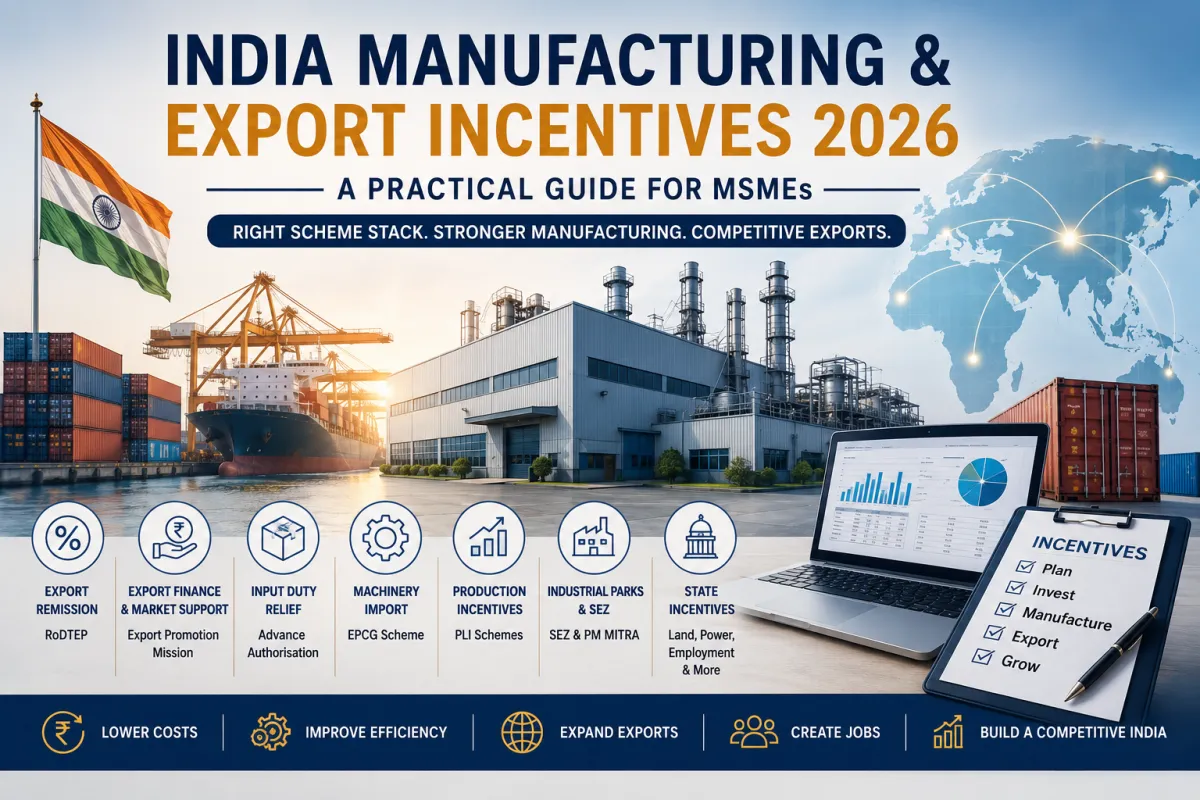
India Manufacturing and Export Incentives 2026: A Practical Guide for MSMEs
India offers several schemes to support manufacturing and exports.
Some schemes reduce customs duty. Some refund embedded taxes. Others support machinery, finance, certification, logistics, production or factory location.
The right scheme depends on the company’s product, market, investment, manufacturing process and export plan.
A business should therefore study incentives before purchasing machinery, signing a land agreement or beginning commercial production.

India has a great vision: USD 2 Trillion by 2030.
Consult Kriba has our free WhatsApp community to support this mission: India 2030: USD 2 Trillion
It has dedicated sector-wise groups for:
Market intelligence
Policy updates
Exporter networking
To join the community, fill out this form:
https://www.consultkriba.com/india2030
What is a scheme stack?
A scheme stack is a planned combination of central, sector and state support.
For example, a manufacturer may examine EPCG for machinery, a state incentive for factory investment, Export Promotion Mission support for certification and RoDTEP on eligible exports.
The purpose is not to claim every available scheme. It is to use only the schemes that solve a clear business problem and can legally be combined.
Start with the business need
Choose the scheme based on the actual cost or business problem.
Recover embedded taxes on exported goods: Check RoDTEP.
Export apparel, garments or eligible textile made-ups: Check RoSCTL.
Need export finance, certification, testing, logistics or market-entry support: Check the Export Promotion Mission.
Import raw materials or components used in export production without customs duty: Check Advance Authorisation.
Import eligible machinery at zero customs duty: Check EPCG. Remember that export obligations will apply.
Manufacture products covered under a selected strategic sector: Check the relevant PLI scheme.
Manufacture eligible electronic components or sub-assemblies: Check ECMS and other current electronics programmes.
Plan a mainly export-oriented factory: Compare an SEZ with a normal industrial location.
Need integrated textile infrastructure: Check PM MITRA parks and other textile clusters.
Need textile workforce development: Check SAMARTH.
Need support for land, electricity, stamp duty, employment, capital investment or SGST: Check the current industrial policy of the state where the factory will be located.
The scheme name alone does not confirm eligibility. Check the latest official notification, product coverage, application window and approval sequence before spending.
1. RoDTEP
RoDTEP means Remission of Duties and Taxes on Exported Products.
It refunds certain embedded central, state and local taxes that are not refunded through another mechanism.
The benefit depends on the correct eight-digit HS code, the current rate and the value cap.
A schedule revision effective from 1 May 2026 added 142 tariff lines, deleted 50 lines and changed two product descriptions.
Exporters should therefore verify the current rate before issuing quotations.
Documents to maintain
IEC and GST records
Correct HS code
Shipping bill declaration
Invoice and packing list
Product-classification evidence
Current RoDTEP notification
Do not treat RoDTEP as a fixed profit margin. Rates and product coverage can change.

2. Export Promotion Mission
The Export Promotion Mission has an approved outlay of ₹25,060 crore for FY 2025–26 to FY 2030–31.
It focuses mainly on MSMEs, first-time exporters and labour-intensive sectors.
The Mission operates through two parts.
Niryat Protsahan
This covers financial support such as:
export credit
factoring
collateral support
e-commerce export finance
support for emerging or higher-risk markets
Niryat Disha
This covers market-readiness support such as:
testing
certification
freight
trade intelligence
overseas warehousing
trade fairs
buyer–seller activities
The Mission can reduce the cost of an export activity. It cannot make an unsuitable market or product commercially viable.
Before applying, define the product, country, buyer type and export barrier.
3. Advance Authorisation
Advance Authorisation allows eligible production inputs to be imported without customs duty when they are used in exported products.
It is usually suitable for manufacturers with a stable bill of materials and reliable production records.
The company must maintain records connecting imported inputs with production and export output.
Prepare
Bill of materials
Input quantities
Manufacturing process
Wastage calculation
Input-output norms
Inventory records
Export-obligation tracker
The scheme may not suit companies whose formulations, materials or production records change frequently.
4. EPCG
The Export Promotion Capital Goods scheme allows eligible machinery to be imported at zero customs duty.
The benefit is linked to an export obligation.
EPCG may be useful when machinery improves export capacity, product quality, lead time or production efficiency.
Check before applying
Machinery description
Supplier quotation
Landed cost
Installation plan
Export forecast
Finance availability
Export-obligation period
Zero customs duty does not mean free machinery.
The company must still finance the equipment and complete the export and reporting obligations.
5. Special Economic Zones
An SEZ is an export-oriented area with customs and operating facilities for approved activities.
Benefits may include duty-free import or domestic procurement and zero-rated GST treatment for supplies to SEZ units.
SEZ units must also follow zone procedures and achieve positive Net Foreign Exchange over the prescribed period.
A new company should compare:
SEZ location
normal industrial location
state-supported industrial park
The comparison should include logistics, labour, suppliers, compliance, domestic sales and operating cost.
Old income-tax holiday information should not be used for a new investment without checking the current law.
6. Production Linked Incentive Schemes
PLI schemes provide incentives for eligible production or sales in selected sectors.
India’s PLI framework covers 14 sectors.
Official information up to 31 December 2025 reported:
more than ₹2.16 lakh crore in investment
more than ₹20.41 lakh crore in production or sales
more than ₹8.3 lakh crore in exports
836 approved applications
PLI is not open to every manufacturer.
Each programme has its own product list, investment threshold, sales requirement, application window and claim conditions.
A project should remain financially workable even if the incentive is delayed.
7. Electronics Manufacturing Schemes
The Electronics Components Manufacturing Scheme was notified in April 2025.
Its focus includes eligible electronic components, sub-assemblies and raw materials.
Companies must check the eligible product list, investment threshold, sales conditions and application window.
Older schemes require caution.
SPECS accepted applications only up to 31 March 2023. M-SIPS closed for new applications in 2018.
EMC 2.0 mainly supports electronics clusters and common infrastructure. It is not a general machinery subsidy for an individual factory.
8. Textile Support
Textile businesses may examine several support routes.
RoSCTL and RoDTEP
Eligible apparel, garments and made-up products may receive RoSCTL.
Other eligible textile products may fall under RoDTEP.
PM MITRA
Seven PM MITRA textile parks have been finalised in Tamil Nadu, Telangana, Gujarat, Karnataka, Madhya Pradesh, Uttar Pradesh and Maharashtra.
The parks provide integrated textile infrastructure. They are not direct cash subsidies for every textile company.
SAMARTH
SAMARTH supports textile-sector skill development through approved training routes.
Textile PLI
Textile PLI applies to selected man-made-fibre and technical-textile products.
Eligibility depends on the notified product and investment conditions.
9. State Industrial Incentives
State governments may provide support for:
land
stamp duty
electricity
employment
training
capital investment
interest cost
SGST
sector infrastructure
The actual benefit depends on the state, district, investment size, company category and policy period.
Timing is important.
Some states require registration or approval before machinery is ordered, investment begins or commercial production starts.
Before investing, obtain confirmation on:
current policy
eligibility
pre-approval requirement
eligible expenditure
benefit ceiling
claim process
policy validity
whether central and state benefits can be combined

How to build the right scheme stack
Step 1: Define the product and market
Choose the product, target country, buyer type, expected price and compliance requirement.
Step 2: Prepare the factory plan
Define land, machinery, capacity, inputs, utilities, labour and environmental requirements.
Step 3: Check central schemes
Review RoDTEP, RoSCTL, EPM, Advance Authorisation, EPCG, PLI, SEZ and sector programmes.
Step 4: Compare state policies
Compare incentives together with power, labour, logistics, supplier and port access.
Step 5: Check scheme combination rules
Confirm that two schemes are not supporting the same machinery, certification or other expense.
Step 6: Model the cash flow
Prepare three calculations:
No incentive
Expected incentive
Delayed incentive
The project should remain commercially workable without immediate reimbursement.
Step 7: Assign responsibility
One person should track every application, certificate, deadline, export obligation and claim.
Three simple examples
Engineering manufacturer
Possible combination:
EPCG for eligible machinery
State industrial incentive
EPM for certification or market support
RoDTEP on eligible exports
The company should validate the product and buyer demand before importing the machine.
Food processor
Possible combination:
State food-processing or industrial support
EPM for testing and certification
Advance Authorisation where input norms fit
RoDTEP on eligible exports
The product, label, shelf life and destination-country rules should be checked first.
Textile manufacturer
Possible combination:
Textile cluster or PM MITRA location
State support
SAMARTH
RoSCTL or RoDTEP
Textile PLI where eligible
The location should be selected based on long-term operating cost, not only the advertised subsidy.
Common mistakes
Purchasing machinery before checking scheme conditions.
Depending on an old scheme summary.
Treating an application acknowledgement as approval.
Assuming every benefit is paid upfront.
Using the wrong HS code.
Maintaining weak production and inventory records.
Missing reporting or claim deadlines.
Claiming the same expense under two schemes.
Choosing a factory location only for the subsidy.
Expanding production without a buyer plan.
Basic readiness checklist
A manufacturer should be able to answer yes to the following:
Product and target market are selected.
The eight-digit HS code is confirmed.
Project cost and machinery details are available.
The current notification has been checked.
Pre-approval requirements are understood.
Eligible and non-eligible spending is separated.
Scheme-combination rules are checked.
Export or production obligations are understood.
Cash flow has been modelled for delayed payment.
One person owns the filing and claim process.
Frequently asked questions
Can RoDTEP and Advance Authorisation be used together?
Separate RoDTEP schedules apply to different export routes. The current product and Appendix 4RE must be checked.
Is EPCG a machinery subsidy?
It is customs-duty relief linked to an export obligation.
Is PLI suitable for every MSME?
No. Eligibility depends on the sector, product, investment, sales threshold and application window.
Can a company apply after buying machinery?
In some schemes, this may make the machinery ineligible. The sequence must be checked before purchase.
Should a company select a state only because the incentive is higher?
No. Labour, power, suppliers, logistics and infrastructure may have a larger long-term impact.
Connecting incentives with export growth
An incentive should improve a real business outcome.
It may help reduce cost, improve machinery, obtain certification, increase capacity or strengthen delivery.
The manufacturer must still select the right product, understand the market, meet buyer requirements, quote correctly and execute the shipment.
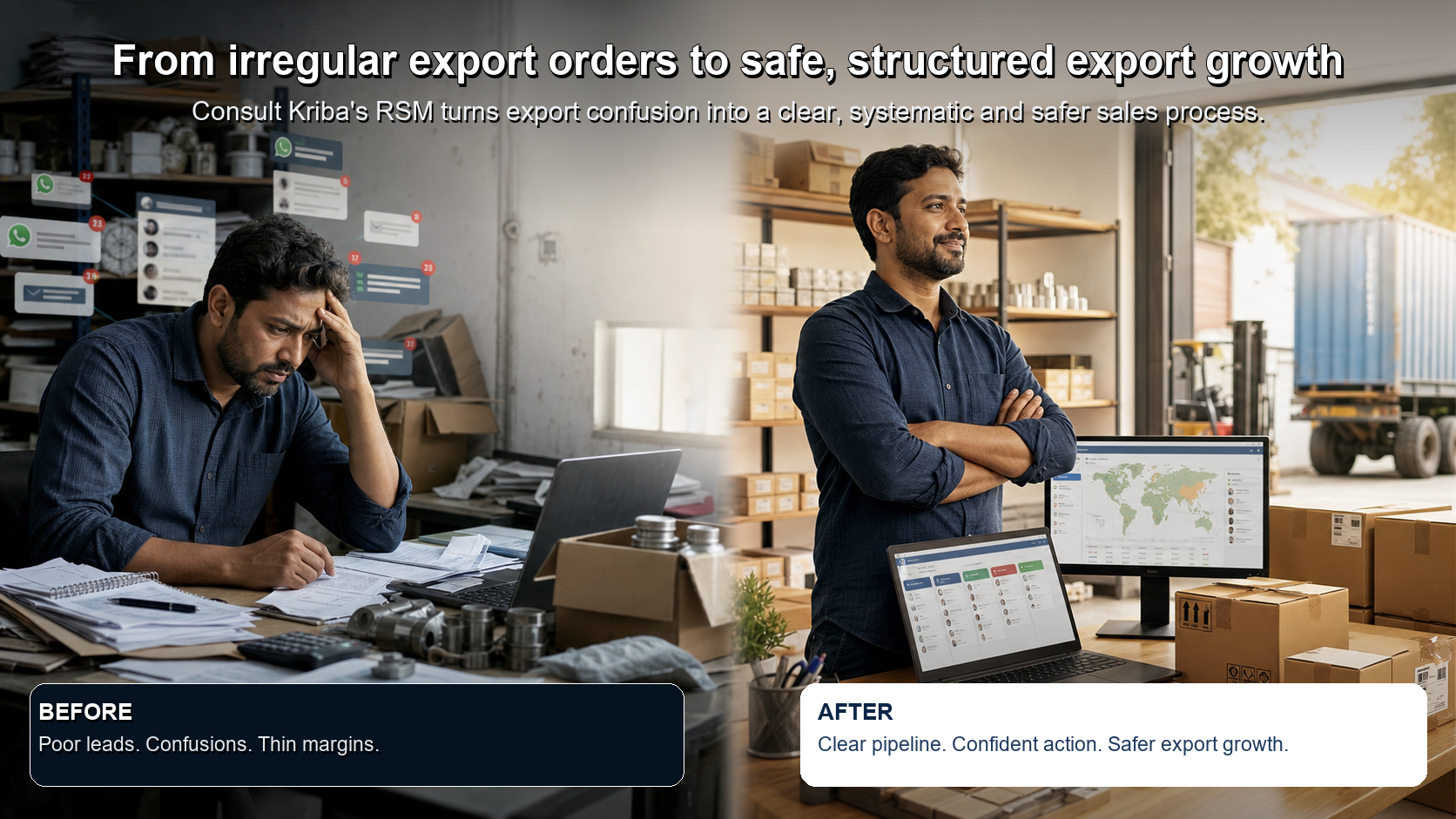
Consult Kriba’s Reverse Sourcing Method connects the incentive decision with product knowledge, market selection, legal compliance, marketing, sales and shipment execution.
Conclusion
Government schemes can improve manufacturing and export economics.
They should be checked before investment, not after spending.
The practical order is:
Product and market → factory plan → scheme selection → documentation → investment → compliance → export sales
Before investing in machinery, certification or factory expansion, check whether the product, market and buyer plan are commercially clear.
Get Your Export Growth Intelligence Report
https://www.consultkriba.com/growthform
Editorial disclaimer
Scheme eligibility, rates, deadlines and application procedures can change.
Verify the latest official notification and obtain professional advice before investing or filing a claim.
