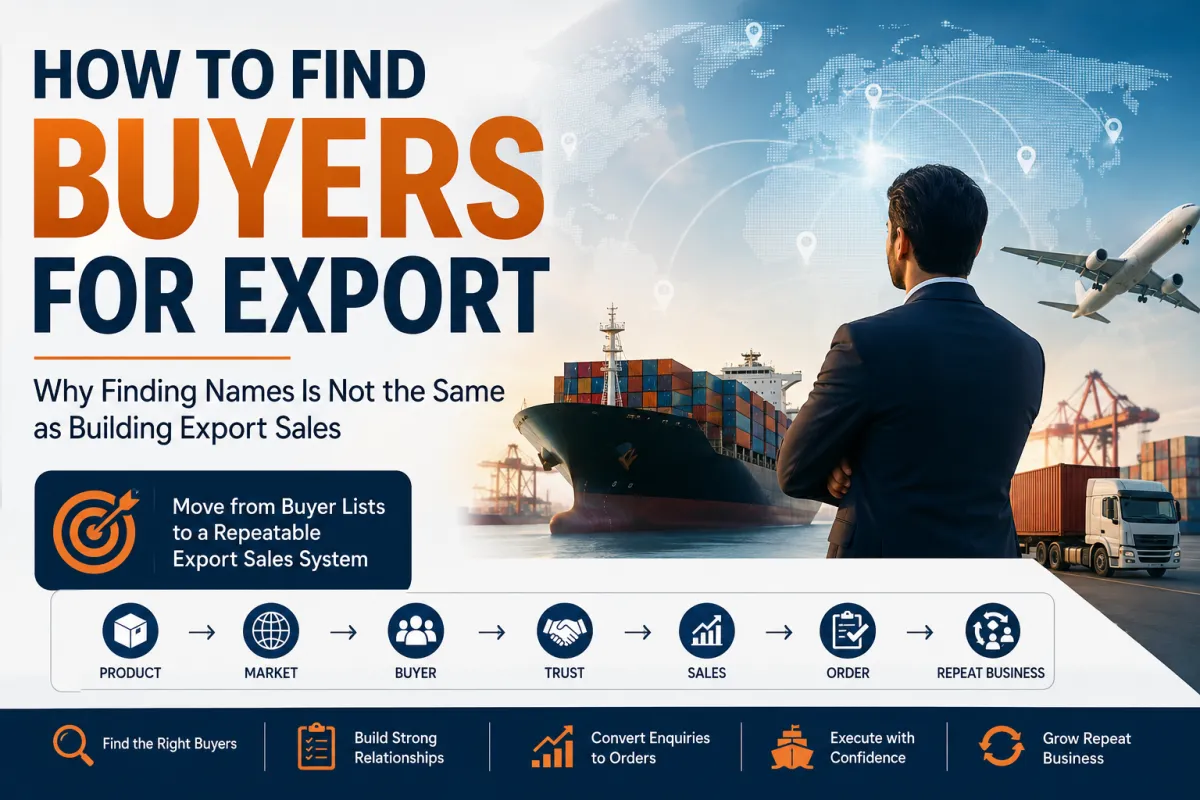
How to Find Buyers for Export: Why Finding Names Is Not the Same as Building Export Sales
How to Find Buyers for Export: Why Finding Names Is Not the Same as Building Export Sales
If you ask an Indian exporter about their biggest challenge, one question appears again and again:
“How do I find buyers?”
Search online and you will find hundreds of answers.
Use customs data. Buy an importer database. Search LinkedIn. Join Alibaba. Attend an exhibition. Contact an Export Promotion Council. Search Google. Use Apollo or ZoomInfo. Send cold emails. Appoint an overseas agent.
None of these methods is automatically wrong.
But they answer only one part of the problem.
A more important question is:
What are you going to do after you find the buyer?
Because:
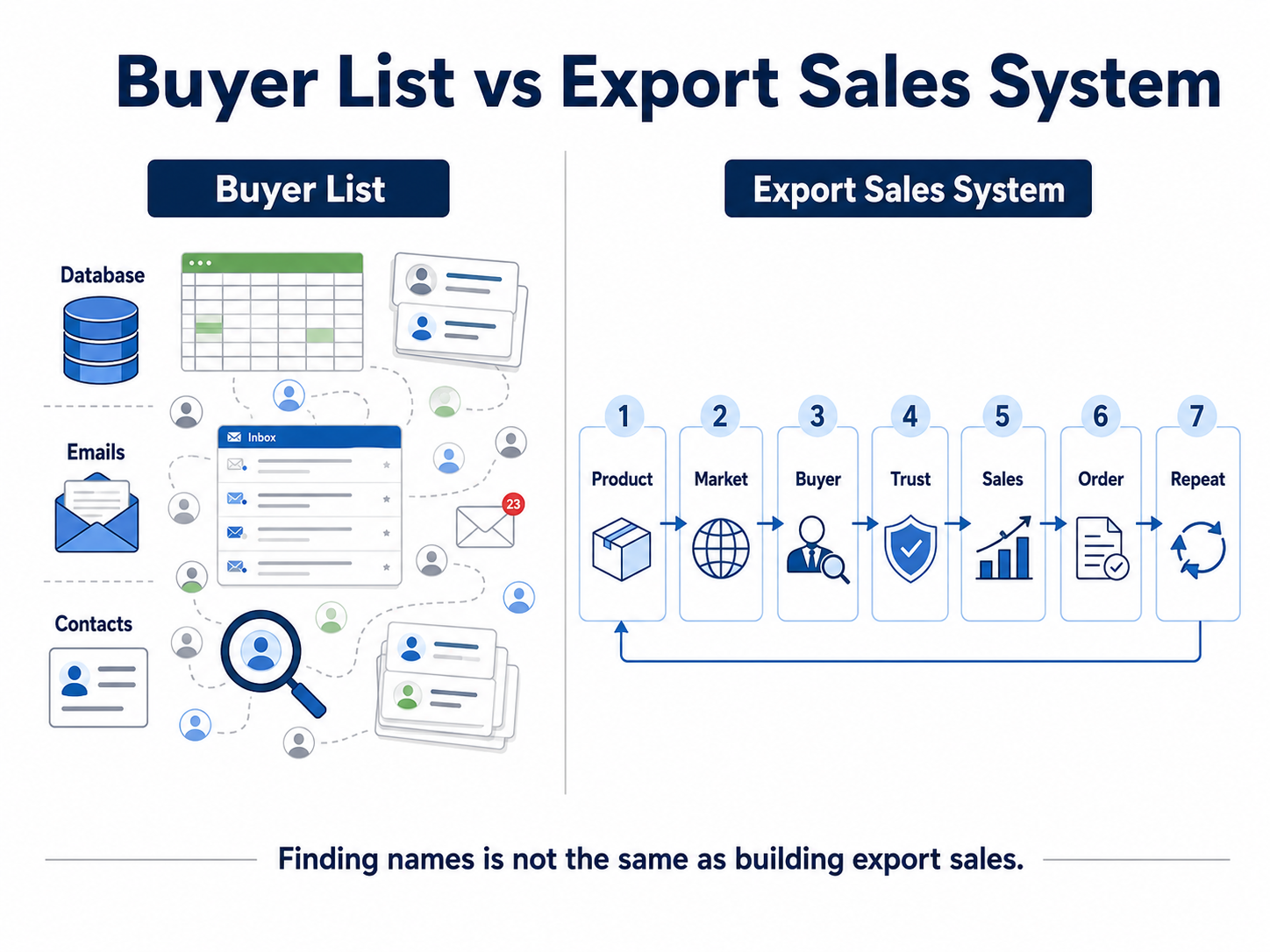
A company name is not a buyer.
An email address is not an opportunity.
A LinkedIn connection is not an enquiry.
An enquiry is not a sale.
And even one export order does not automatically create a sustainable export business.
The actual export-sales journey is much longer:
Product → Market → Buyer Type → Business Fit → Trust → Conversation → Requirement → Quotation → Negotiation → Purchase Order → Shipment → Payment → Repeat Business
This is the basic thinking behind Consult Kriba’s Reverse Sourcing Method (RSM).
RSM does not tell exporters to stop using databases, customs information, LinkedIn, exhibitions, trade associations, agents or email.
It changes the order.
Instead of beginning with:
“Where can I find buyers?”
RSM begins with:
“Which buyer has a real reason to buy this particular product from our business, and what must we prepare before approaching them?”
That difference looks small.
Commercially, it changes almost everything.
Consult Kriba’s 3-Day Export Sales Process Workshop helps you understand where your export opportunity lies, what buyers expect and how to start building a stronger buyer network using the Reverse Sourcing Method.
Join the 3-Day Export Sales Process Workshop
https://www.consultkriba.com/2tnexports
Why Traditional Buyer Finding Often Produces Activity but Not Sales
The regular export buyer-finding process often looks like this:
Select a product.
Find countries importing it.
Download hundreds or thousands of importer names.
Find their emails or LinkedIn profiles.
Send a catalogue and introduction.
Ask for requirements.
Follow up repeatedly.
Get very few meaningful replies.
Decide that the database, market or platform “does not work”.
Buy another database and repeat.
The exporter may be doing a lot of work.
But much of that activity happens before answering the buyer’s real questions.
A serious overseas buyer may be thinking:
Can this supplier meet our exact specification?
Can they maintain the quality for every batch?
Does India have an advantage for this product?
What certifications are available?
Can they handle our normal quantity?
Can they customise the product?
What is the actual lead time?
Can they handle our packaging?
What happens when there is a quality problem?
What payment terms will they expect?
Do they understand our market?
Will communication remain good after receiving the order?
The exporter is thinking:
“Will you buy from me?”
The importer is thinking:
“Why should I take the risk of buying from you?”
That gap explains a large part of poor export conversion.
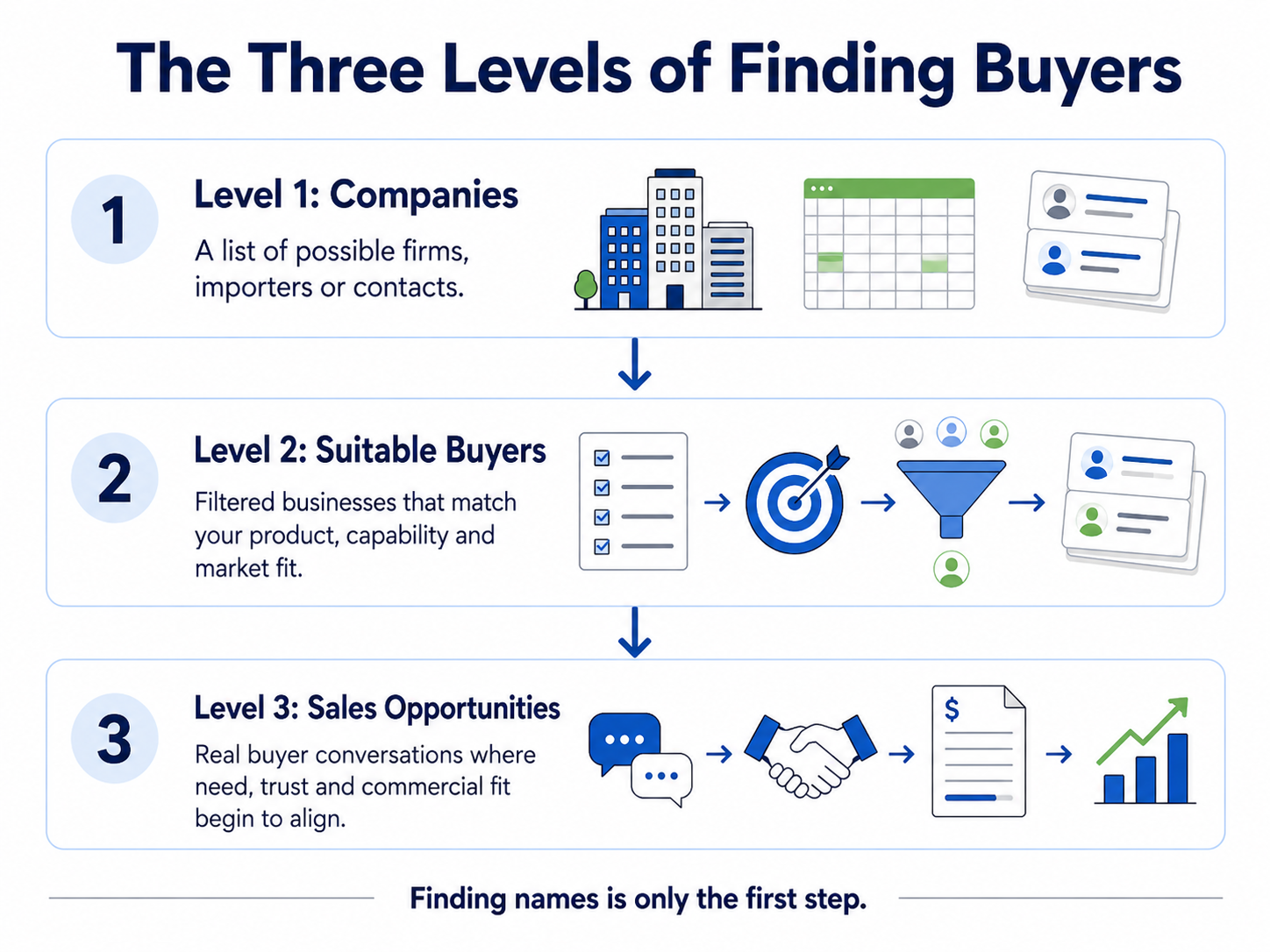
There Are Actually Three Levels of “Finding Buyers”
The phrase “finding buyers” hides three very different jobs.
Level 1: Finding Companies
This is mainly a data problem.
Suppose you export food ingredients to the UAE.
You may identify:
ingredient distributors;
food manufacturers;
importers;
wholesalers;
foodservice suppliers;
supermarket groups.
Today, Google, LinkedIn, customs information, databases and AI can help identify hundreds of companies quickly.
But these are still only companies.
They have not yet become buyers for you.
Level 2: Finding Suitable Buyers
Now the real filtering begins.
A technically relevant company may still be unsuitable because:
its normal orders are much larger than your capacity;
it needs certifications you do not have;
it buys only through approved local distributors;
its target price is below your workable price;
it needs 60 or 90 days' credit that you cannot finance;
its specification does not match your manufacturing capability;
its buying season has already passed;
it has long-term supplier contracts;
it is not currently adding vendors.
Your list may reduce from 1,000 companies to 100.
That is not a failure.
That is progress.
The objective should not be to create the biggest buyer database.
The objective should be to create the most commercially relevant database.
Level 3: Creating a Sales Opportunity
This is where export selling actually starts.
A suitable buyer becomes an opportunity when several conditions begin to align:
Buyer need + supplier capability + commercial feasibility + trust + timing
The buyer may first check your website.
Then your LinkedIn profile.
Then certifications.
Then your factory or supplier capability.
They may compare India against China, Vietnam, Turkey, Germany, Bangladesh or another source.
They may ask for samples.
They may require another specification.
They may not review new suppliers until their next buying season.
Therefore, exporters do not simply “find” many buyers.
They often have to develop a commercial relationship until a buying opportunity becomes possible.
That requires a system beyond lead generation.
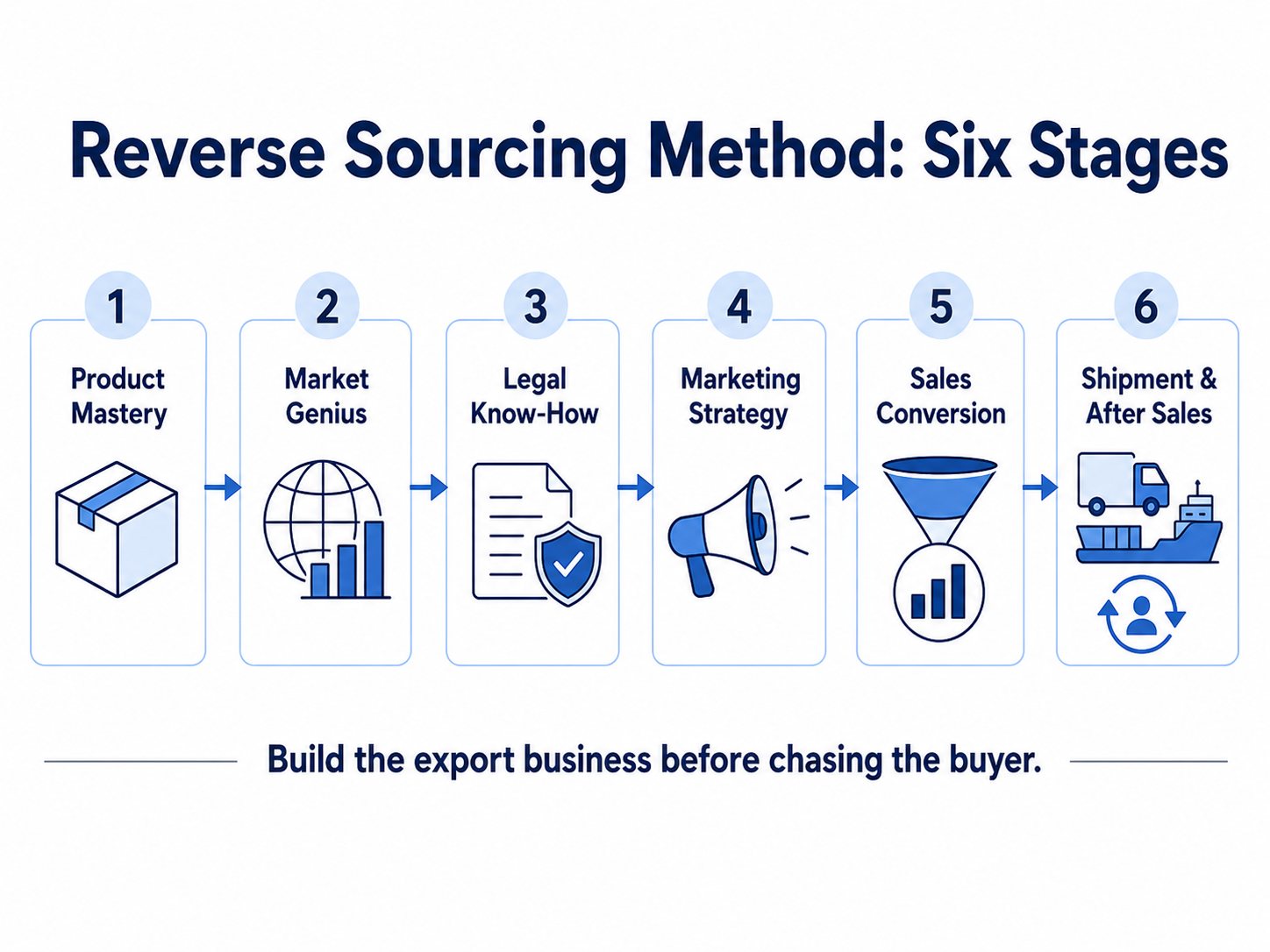
Reverse Sourcing Method: Build the Export Business Before Chasing the Buyer
Consult Kriba’s Reverse Sourcing Method connects buyer development to six areas:
Product Mastery
Market Genius
Legal Know-How
Marketing Strategy
Sales Conversion Process
Shipment & After Sales
The logic is simple.
Do not begin serious buyer outreach before understanding what you are selling, where it fits, whether you can legally and commercially execute it, how you will build trust, how you will manage the sales conversation, and what happens after receiving the order.
1. Product Mastery: Know What You Can Really Sell
Many exporters begin with:
“This product has export demand. Let us find buyers.”
RSM asks a more difficult question:
“What exactly can we competitively and reliably supply?”
Knowing only the product name or HS code is not enough.
An exporter should understand areas such as specification, grade, dimensions, composition, application, variants, packaging, production location, seasonality, shelf life, manufacturing capacity, lead time, quality risks, certifications and competing products.
Then comes a second question:
What is our real advantage?
Depending on the business, that could be:
competitive pricing;
certifications and quality systems;
customisation;
product range;
technical knowledge;
flexible production;
sourcing strength;
application knowledge;
reliable delivery.
This matters because two Indian companies selling the same product may need completely different buyers.
A high-volume supplier may suit a large distributor.
A flexible manufacturer may suit a private-label buyer.
A certified factory may suit a highly regulated manufacturer.
A sourcing company with access to several controlled suppliers may suit a multi-product importer.
The product alone does not decide the buyer.
Your capability helps decide the buyer.
2. Market Genius: A Big Import Market Is Not Automatically Your Best Market
Trade data is important.
But one of the most common mistakes is:
“Country X imports USD 500 million of my product. Therefore, we should target Country X.”
That conclusion is incomplete.
Market size is only one variable.
The exporter should also study:
demand growth;
supplier countries;
India's existing share;
competitors;
substitute products;
tariffs;
trade agreements;
regulations;
logistics;
buyer structure;
payment practices;
local language;
business culture;
distribution;
import hubs;
political and economic conditions.
RSM studies the wider market using social, technological, economic, environmental and political/regulatory factors.
Consider two markets.
Country A
Imports USD 500 million of your product, but three suppliers dominate it. Prices are extremely competitive, buyers demand certifications you lack, and payment terms are difficult.
Country B
Imports only USD 80 million, but demand is growing, Indian participation is low, your specification suits an important local application, and several distributors are looking for alternate sources.
Which is the better market?
There is no correct answer based only on import value.
The better market is the one where:
demand + competitive position + exporter capability + buyer need + commercial feasibility
create a stronger opportunity.
3. Legal Know-How: Can You Complete the Sale After the Buyer Says Yes?
This is where many buyer-finding strategies break.
The exporter celebrates the enquiry.
Then the buyer asks:
Can you quote CIF?
Which HS code are you using?
Can you provide the required Certificate of Origin?
Does the product comply with our local standard?
Can you accept an LC?
Can you supply under DDP?
Which documents will accompany the shipment?
Does the product qualify for preferential duty under the applicable trade agreement?
Now the exporter starts learning.
That is late.
Before serious sales activity, an exporter should understand the applicable registrations, product-specific compliance, HS classification, documentation, Incoterms, payment methods, foreign-exchange risks, logistics, packaging, GST treatment and contractual risks.
Why?
Because an export sale is not complete when a buyer says:
“Your price is acceptable.”
A successful export sale means reaching a commercially workable transaction that you can legally execute, ship safely and collect payment for.
4. Marketing: A Buyer Database Still Contains People Who Do Not Know You
Imagine receiving this email:
Dear Sir,
We are leading manufacturers and exporters from India. We offer best quality at competitive price. Please send your requirement.
Would it make you trust the supplier?
Probably not.
Yet international buyers receive countless messages like this.
Once you have found a company, you are still a stranger.
That means the next job is not simply sending a catalogue.
The next job is reducing the buyer's uncertainty about you.
That can happen through your website, LinkedIn presence, useful content, technical knowledge, certifications, customer proof, industry involvement, exhibitions, referrals and professional communication.
When a buyer searches for you, they should understand:
what you specialise in;
what capability you have;
what markets you understand;
what products you actually handle;
what expertise exists inside the business;
what evidence supports your claims.
This builds something a database cannot give you:
reputation.
And reputation compounds over time.
5. Sales Conversion: A Reply Is Only the Beginning
Traditional lead generation commonly measures:
“How many contacts did we find?”
“How many emails did we send?”
“How many people replied?”
“How many enquiries did we receive?”
RSM looks further.
A buyer conversation should move through defined commercial stages.
Consult Kriba’s sales process uses five main stages:
Clear Requirement → Quotation → Negotiation → Purchase Order → Execution and Payment Realisation
Before quoting, the exporter should understand the buyer's actual requirement.
That can include specification, quantity, packaging, required delivery date, Incoterm, payment term, destination port, certifications and other commercial conditions.
Only then can the exporter calculate whether the requirement is commercially workable.
After quotation comes follow-up.
Then objections.
Then negotiation.
Then the purchase order.
Then execution.
Then payment.
Therefore:
“We have 5,000 leads” is not a meaningful sales KPI by itself.
A business with 20 relevant buyer conversations progressing through defined stages may have a much stronger export pipeline than a company holding 5,000 unused contact records.
6. Shipment and After Sales: The Buyer-Finding Process Does Not Finish With the PO
An export order creates an opportunity.
Execution decides whether it can become a relationship.
The exporter must still manage production, quality, packing, labelling, documentation, freight, customs clearance, shipment tracking, payment realisation and buyer communication.
Then comes something many exporters ignore:
What happens after delivery?
Was the buyer satisfied?
Was the product accepted smoothly?
Was there a complaint?
Can the next order be forecast?
Can another product be introduced?
Can this buyer give a reference?
Can this relationship introduce you to another market?
Finding a brand-new buyer for every shipment is expensive.
Building customers who reorder is far more powerful.
A first order should therefore not be treated as the finish line.
It should be treated as the beginning of a customer account.
Traditional Buyer Search vs Reverse Sourcing Method
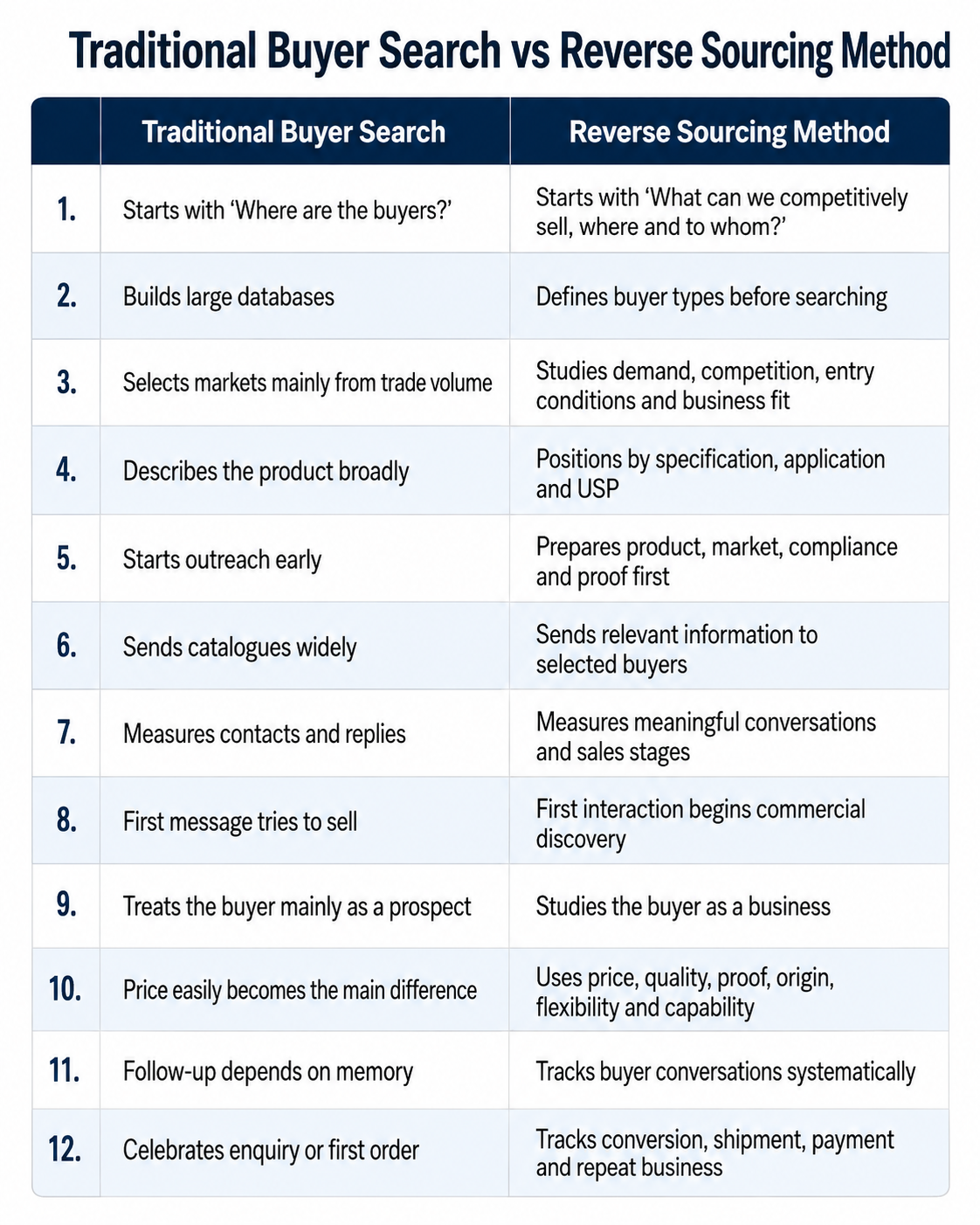
The important point is that RSM can still use the same tools.
LinkedIn can be part of RSM.
Customs data can be part of RSM.
Trade Map can be part of RSM.
Email can be part of RSM.
Trade fairs can be part of RSM.
Agents can be part of RSM.
AI can be part of RSM.
The difference is what happens before, during and after the tool is used.
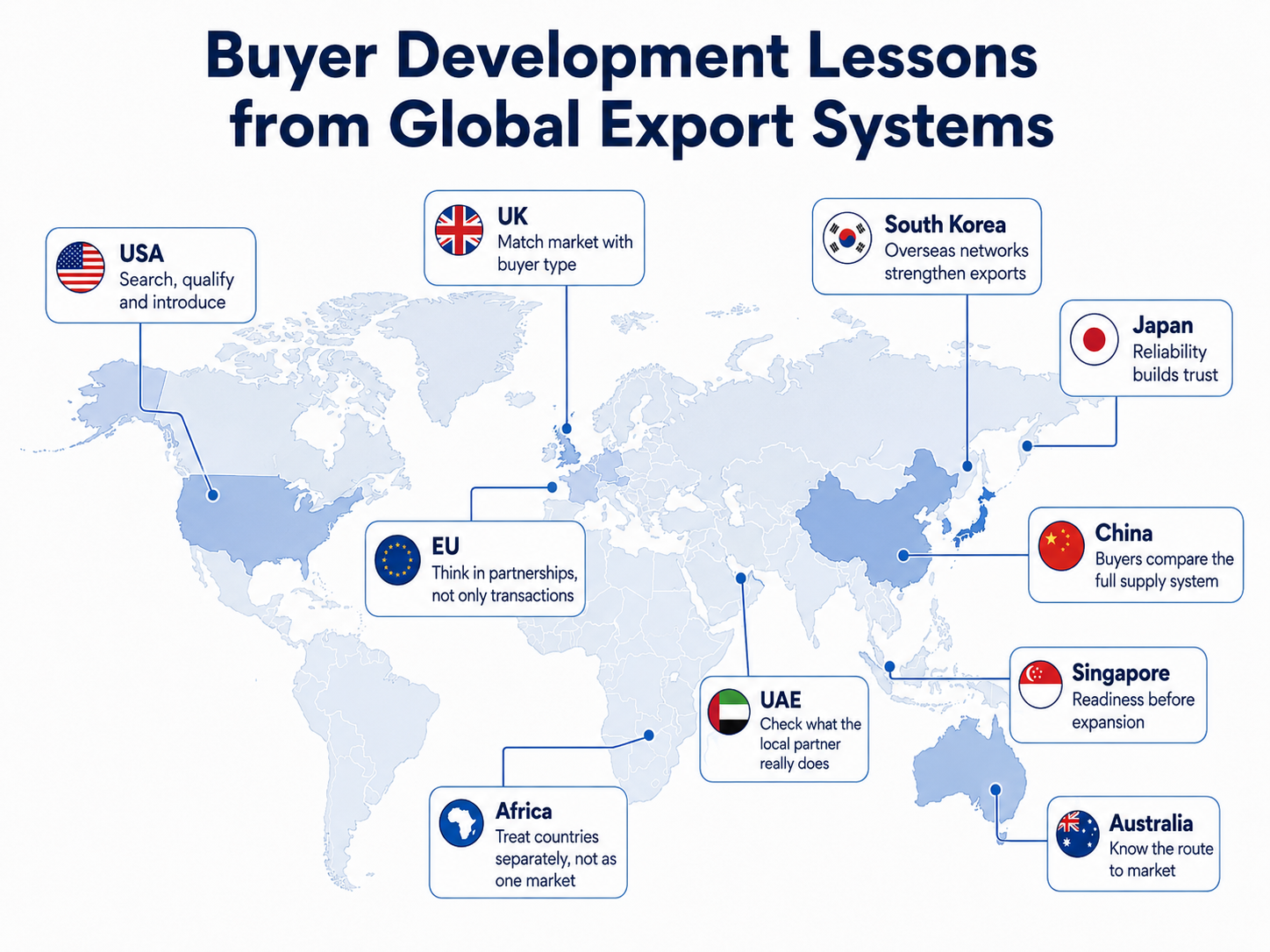
What Can Indian Exporters Learn From Other Countries?
Established export-support systems give us an important clue.
They usually do not treat internationalisation as:
“Here is a database. Start sending emails.”
They combine market knowledge, company readiness, partner search, qualification, local support, introductions and business development.
United States: Search, Qualify and Introduce
The U.S. Commercial Service's International Partner Search is designed around identifying potential partners and checking their interest.
Its Gold Key Service goes further by helping arrange meetings with suitable companies.
The commercial logic is important:
Identify → Contact → Check Interest → Profile → Introduce → Meet
Market selection, partner identification and due diligence are treated as different jobs.
Indian exporters should do the same.
Japan: Business Matching Matters
JETRO supports Japanese businesses through market information, exhibitions, overseas company identification and business matching.
The important idea is not simply discovering a buyer's name.
It is creating conditions for two businesses to evaluate whether working together makes sense.
Japan also provides another lesson: in many business relationships, reliability, specification discipline, punctuality and consistency can matter more than aggressive selling.
Singapore: “Market Readiness” Comes Before Market Expansion
Singapore's Market Readiness Assistance programme has an important idea built into its name:
readiness.
International expansion is wider than buyer generation.
It includes developing the ability to operate in another market.
That is exactly where many exporters go wrong.
They ask whether buyers exist before asking whether they themselves are ready to serve those buyers.
Australia and the UK: Understand the Route to Market
Export-support systems in Australia and the UK also emphasise market information, overseas connections and market-entry support.
The lesson for Indian exporters is straightforward:
Knowing the country is not the same as understanding the route to market.
A German industrial distributor, a Saudi supermarket buyer, a Nigerian commercial agent and a UK private-label retailer cannot be evaluated using the same approach.
South Korea: Export Strength Includes Overseas Networks
South Korea's export ecosystem, including KOTRA, has historically combined overseas offices, market intelligence, exhibitions and business matching.
This highlights an important point.
A country's export strength is not created only by factories.
It is also created by commercial networks outside the country.
European Union: Think in Partnerships, Not Only Transactions
European internationalisation networks often work around distributors, partnerships, technology relationships and commercial cooperation.
An exporter should therefore build a wider network around the buyer.
A future order may come through a distributor, consultant, chamber, technical specialist, existing customer, another supplier or referral.
International trade is often a network business.
UAE and the Gulf: Understand What the Local Partner Actually Does
Finding an importer in the UAE can be relatively easy.
Understanding whether that importer can actually develop your product is harder.
The business may need warehousing, project relationships, retail access, re-export capability, credit capacity or regulatory support.
A trader, distributor, construction-material stockist and project supplier may all technically be “buyers”.
Commercially, they are very different.
China: Buyers Compare Entire Supply Systems
China's strength in many sectors is not simply cheap labour.
Dense manufacturing ecosystems connect factories, component suppliers, tooling, packaging, traders, logistics providers and export experience.
An Indian supplier may offer a lower factory price.
But if the competing supplier samples faster, answers technical questions faster, documents better and executes more smoothly, the buyer may still choose the competitor.
The buyer is evaluating the complete supply experience.
Africa: Never Treat a Continent as One Market
Nigeria, Ghana, Kenya, Tanzania, South Africa, Egypt and Morocco have different currencies, ports, regulations, payment conditions and distribution structures.
A database titled “African Importers” can therefore create more confusion than opportunity.
Exporters need country-level understanding.
The Five Functions Behind Serious Export Development
Across these international models, a pattern appears.
Successful export development generally combines:
Market intelligence — Where does a realistic opportunity exist?
Exporter readiness — Can we actually serve that opportunity?
Buyer and partner identification — Who controls access to the opportunity?
Relationship development — How do we begin a meaningful commercial conversation?
Execution and repeat business — Can we convert, deliver, collect payment and grow the account?
That logic is very close to Reverse Sourcing Method.
Does This Mean Buyer Databases Are Bad?
No.
Database-first buyer finding has genuine strengths.
It is fast.
It creates market visibility.
Customs information can show existing trading relationships.
Company research helps exporters understand how an industry is organised.
Outbound prospecting allows you to create opportunities instead of waiting for someone to discover you.
AI now makes the research much faster.
The problem begins when the database itself becomes the strategy.
Five thousand contacts do not mean 5,000 opportunities.
Generic outreach can force the conversation towards price.
Poorly qualified enquiries consume management time.
Samples cost money.
Quotations take effort.
Follow-up consumes resources.
And sending 500 emails can create the feeling of progress even when no serious sales opportunity is moving.
The database should therefore support the export-sales process.
It should not replace it.
Why Reverse Sourcing Builds a Stronger Export Business
RSM is not another lead-generation technique.
Its main advantage is that the work begins to create assets inside the business.
Product research builds product intelligence.
Market research builds country knowledge.
Buyer conversations improve commercial understanding.
Objections improve the offer.
Quotations improve costing discipline.
Negotiations improve sales capability.
Content and proof improve reputation.
Shipment experience improves execution.
Customers create references.
Repeat orders create stronger economics.
This means every cycle should leave the exporter stronger than before.
That is very different from repeatedly purchasing new lists and starting again from zero.
The Long-Term Difference: Two Exporters After Three Years
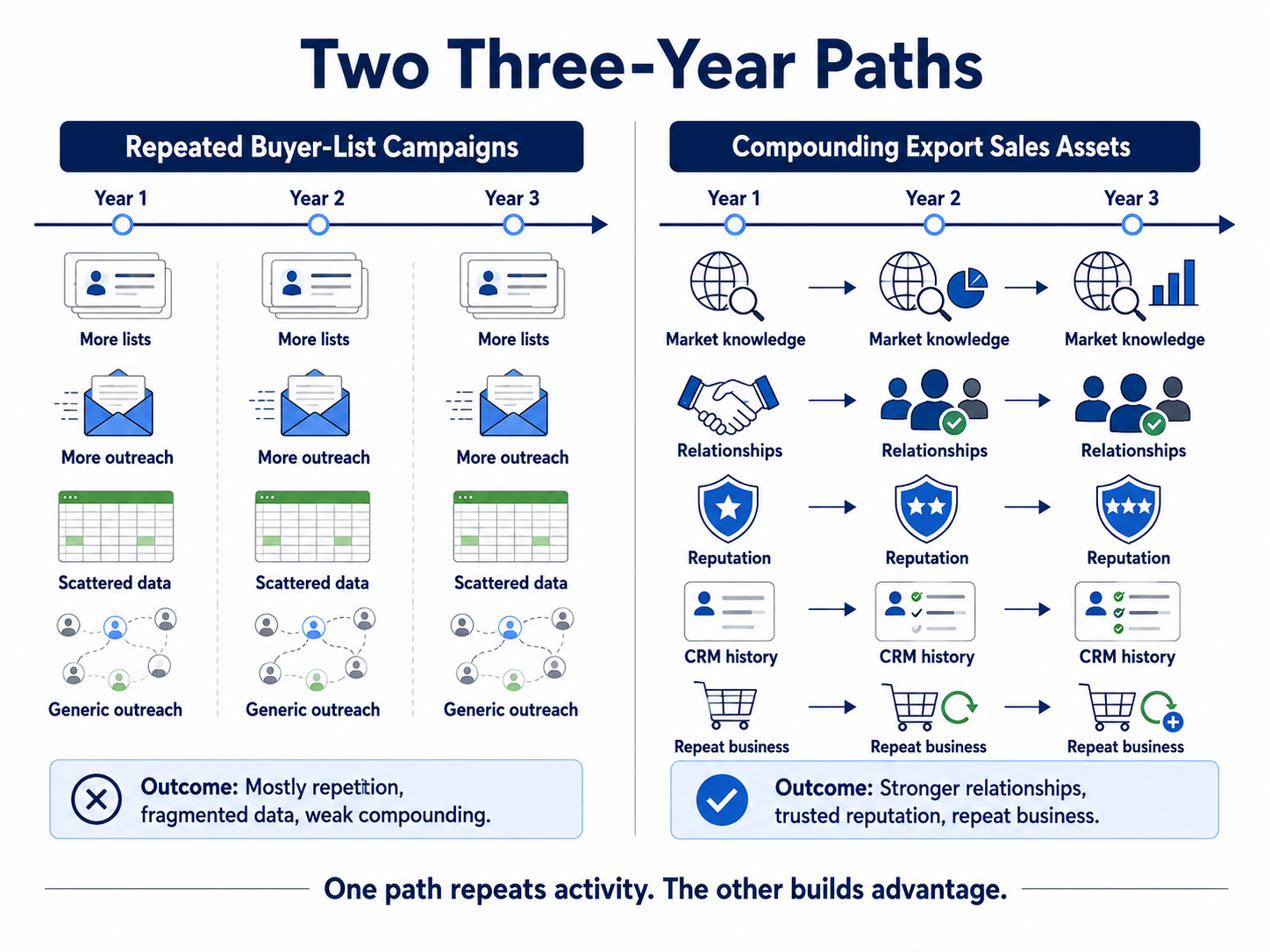
Imagine two exporters spend three years searching for overseas buyers.
Exporter A repeatedly buys lists and runs outreach campaigns.
After three years, the business may have thousands of old contacts, bounced emails, scattered quotations and perhaps some customers.
Exporter B uses every sales campaign to improve product knowledge, competitor intelligence, target markets, buyer categories, relationships, CRM history, negotiation capability, content, reputation, customer references and repeat-order processes.
After three years, Exporter B has built something much harder to copy:
an export-sales asset.
A competitor can buy the same database tomorrow.
It cannot instantly copy three years of:
market learning;
buyer relationships;
successful shipments;
negotiations;
references;
product improvements;
customer feedback;
reputation;
execution experience.
That is why the long-term goal should be bigger than lead generation.
AI Is Making Buyer Names Cheaper. That Makes Strategy More Important.
Artificial intelligence is changing buyer research quickly.
Exporters can increasingly use AI to research markets, study companies, identify buyer categories, summarise websites, study competitors, draft messages, examine regulations and manage sales information.
Information that previously required hours can sometimes be collected much faster.
This creates an important consequence.
If every supplier can find the same buyer, finding the name itself becomes less valuable.
The competitive advantage moves to different questions:
Who understands the buyer better?
Who looks more credible?
Who communicates more clearly?
Who understands the application?
Who provides the right evidence?
Who responds quickly?
Who follows up properly?
Who handles commercial questions confidently?
Who executes the shipment properly?
Who makes the buyer comfortable ordering again?
AI can speed up research.
It cannot replace the commercial logic that decides what research matters and what action should follow.
That is where a structured method becomes more important, not less.
Example: Two Exporters Find the Same UK Buyer
Suppose a UK importer sells women's private-label cotton sleepwear.
Both exporters find the same company.
Exporter A
Sends a standard email:
Dear Sir/Madam,
We are leading manufacturers and exporters of garments from India. We offer best quality at competitive prices. Please find our catalogue attached. Kindly send your requirement.
The attached catalogue contains 300 products.
Exporter B
Studies the company.
They discover that the buyer focuses on mid-market women's private-label sleepwear.
The exporter already knows the relevant fabric specifications, MOQ, capacity, shrinkage performance, certifications, packaging, sample timeline, UK requirements and realistic price range.
The communication becomes specific:
I noticed that your women's sleepwear range mainly uses cotton and cotton-blend private-label products. We manufacture this category in Tiruppur and can support smaller private-label runs with controlled sizing and shrinkage testing. If you review suppliers for the next season, I can share a short product sheet covering fabric options, MOQ, sample timeline and the compliance documents currently available.
Both exporters found the same buyer.
The advantage did not come from the database.
It came from preparation, relevance and sales quality.
What Should a Beginner Exporter Do?
Do not spend your first month collecting thousands of buyer contacts.
Start with this sequence.
Step 1: Select a focused product
Know exactly what you can supply rather than promoting everything available to you.
Step 2: Identify your strength
Why should the buyer consider your business?
Price? Certification? Customisation? Range? Technical capability? Flexible quantities?
Step 3: Study a few markets properly
Do not target the whole world simultaneously.
Step 4: Identify the correct buyer categories
Understand who actually buys your product and why.
Step 5: Check legal and commercial feasibility
Confirm compliance, logistics, pricing and payment before serious outreach.
Step 6: Build buyer-facing proof
Prepare your product sheet, profile, certifications, test reports, business information and other evidence.
Step 7: Build a focused buyer list
Research relevance before volume.
Step 8: Start conversations
The first objective is not always an order.
It is to understand whether a business fit exists.
Step 9: Track the sales process
Use a CRM or at least a structured tracker.
Step 10: Learn from every interaction
A buyer objection is market intelligence.
A rejected quote is pricing intelligence.
A sample request is product intelligence.
A delayed decision can reveal the buyer's purchasing cycle.
Capture that learning.
What Should an Experienced Exporter Do?
Experienced exporters should ask a different question:
“Where is our current export-growth system underperforming?”
Review areas such as country concentration, dependence on one distributor, falling margins, price competition, certification advantage, customer concentration, products that can be customised, cross-selling opportunities, lost quotations, repeat-order potential and weak markets.
Also ask:
How much market knowledge exists only in one employee's head?
Would that knowledge disappear if that employee left?
A mature export-sales system should turn experience into organisational knowledge.
RSM can therefore help experienced exporters improve diversification, buyer quality, margins, customer development and resilience rather than merely finding new names.
Finding Buyers Should Become a Managed Business Process
An export business should not depend permanently on one exhibition, one agent, one importer, one database or one lucky enquiry.
Management should be able to see the pipeline.
For example:
How many priority markets are we developing?
How many suitable buyer accounts are active?
How many meaningful conversations are progressing?
How many clear requirements have we received?
How many quotations are open?
What objections appear repeatedly?
Which markets convert better?
Where are margins becoming weak?
Which buyers are ready for repeat orders?
Once these questions can be answered, exports stop looking like isolated buyer searches.
They become a managed sales function.
The Question Exporters Should Stop Asking Alone
Continue asking:
“How can I find buyers for export?”
You still need buyers.
But do not ask that question alone.
Also ask:
Which market should I focus on?
Which type of buyer should I approach?
Why should that buyer consider India?
Why should the buyer choose my business?
What evidence will reduce their risk?
And finally:
How can I build a system that continues creating opportunities instead of starting again from zero every few months?
That final question separates a buyer-finding technique from an export-growth strategy.
A Practical RSM Buyer-Finding Checklist
Before broad outreach, check seven areas.
Product: Do you know the exact product, specification, application, MOQ, capacity, lead time and strongest commercial advantage?
Market: Can you explain why the selected country fits your product and business? Do you know the competitors, tariffs, logistics and market-entry conditions?
Buyer: Have you identified the correct buyer categories? Do you know why the target company might actually need your product?
Proof: Are your website, profile, certificates, technical documents, product sheets and business information strong enough for a buyer to verify your claims?
Sales: Can you track requirements, quotations, objections, negotiations and next actions systematically?
Execution: Can you quote safely, agree workable payment terms, handle shipment responsibility and consistently deliver what was approved?
Growth: Do you have a system for feedback, repeat orders, referrals and additional products?
If several answers are weak, buying another 5,000-row database is unlikely to solve the real problem.
Strengthen the export-sales system first.
Finding Buyers Is an Activity. Building an Export Market Is a Strategy.
Databases are useful.
LinkedIn is useful.
Trade fairs are useful.
Trade statistics are useful.
Customs data is useful.
AI is useful.
Agents are useful.
Government export programmes are useful.
But none of these tools alone is an export-sales strategy.
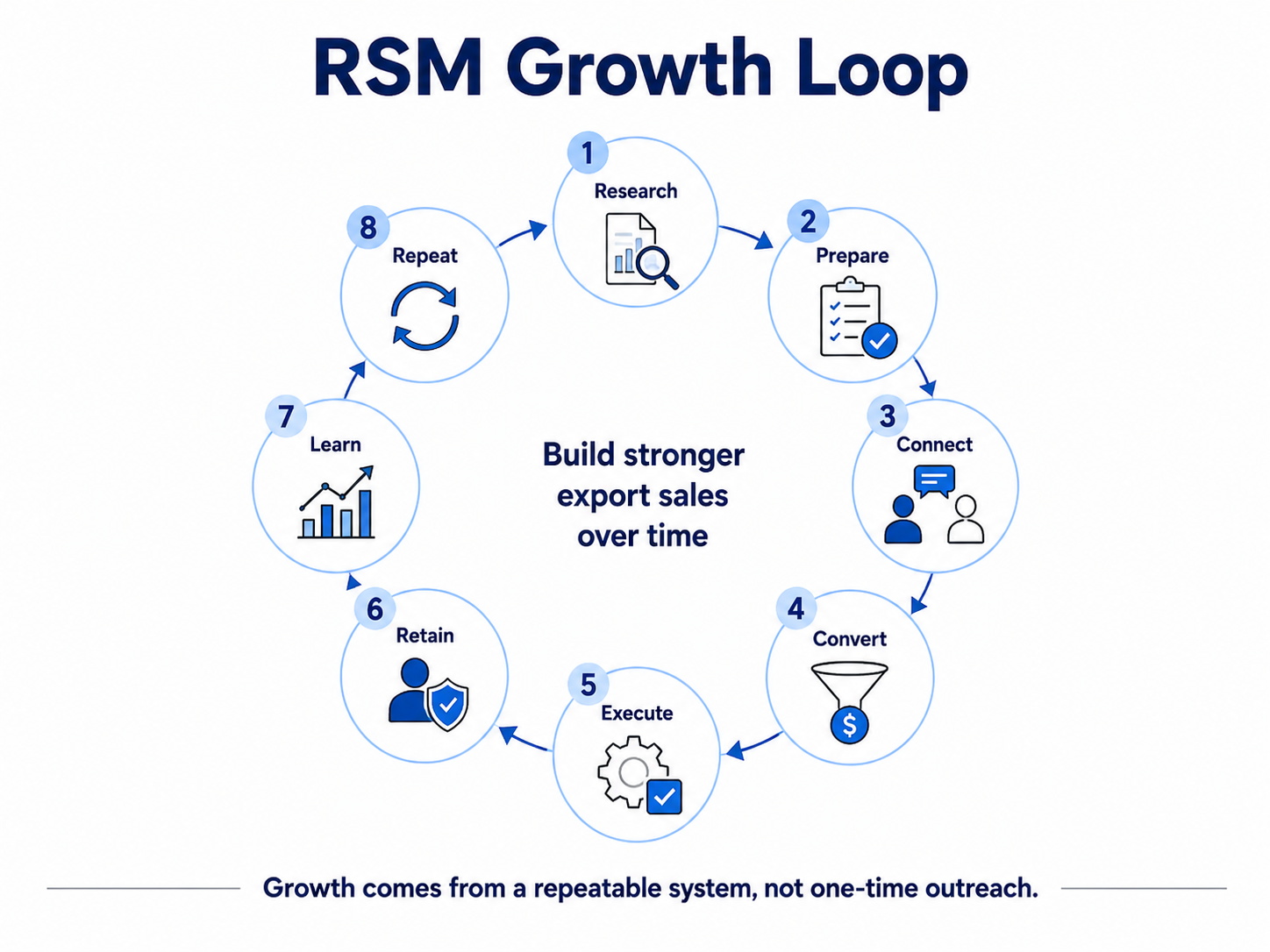
A stronger process is:
Master the product.
Understand the market.
Know the rules.
Build credibility.
Identify and develop the right relationships.
Convert requirements into commercially workable sales.
Execute correctly.
Collect payment.
Retain the customer.
Grow the account.
Repeat.
That is how an export business becomes stronger over time.
Where Consult Kriba Fits
Consult Kriba helps exporters move from finding overseas buyers to closing export sales using the Reverse Sourcing Method.
The method connects the commercial chain:
Product → Market → Buyer → Proof → Conversation → Requirement → Quotation → Negotiation → Order → Execution → Repeat Business
For a beginner, this provides structure before expensive mistakes happen.
For an experienced exporter, it helps identify where the existing growth process is breaking: market choice, buyer relevance, proof, follow-up, pricing, negotiation, execution or repeat orders.
The objective is not merely to generate another buyer list.
It is to build a repeatable export-sales capability inside the business.
Want to Work Through This Process?
Consult Kriba's 3-Day Export Sales Process Workshop follows the same practical sequence:
Prepare → Find the Right Buyers → Start the Sales Process
Instead of beginning with random buyer databases, exporters work through their export opportunity, buyer direction and next sales actions using the Reverse Sourcing Method.
Because finding buyers should not be the final goal.
Building a sales system that continues finding, developing and converting the right opportunities should be.
https://www.consultkriba.com/2tnexports
Sources and Further Reading
Consult Kriba — Reverse Sourcing Method six-stage framework and buyer-development tools
International Trade Centre — Trade Map
U.S. Commercial Service — International Partner Search
U.S. Commercial Service — Gold Key Service
Japan External Trade Organization — JETRO
Enterprise Singapore — Market Readiness Assistance
Australian Trade and Investment Commission — Austrade
UK international business and export-support resources
Korea Trade-Investment Promotion Agency — KOTRA
Enterprise Europe Network
OECD research on SME internationalisation and barriers to international business partnerships
